Introduction:
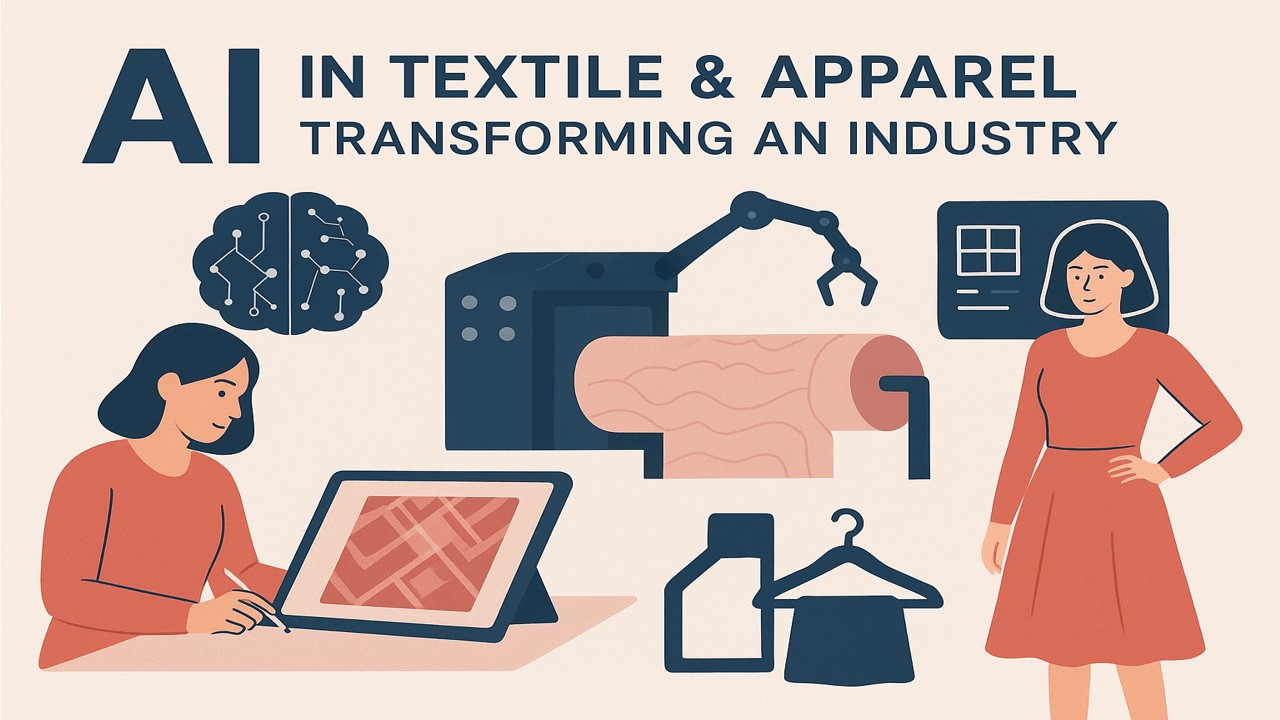
Artificial Intelligence (AI) is no longer an experiment in textiles and apparel; it is an integral thread woven through design, manufacturing, supply chains, retail, and sustainability. Technologies such as machine learning (ML), deep learning, computer vision, generative AI, and digital twins are enabling data-driven creativity, real-time quality control, predictive analytics, and circular economy practices. Research by Kumar et al. (2024) shows that AI adoption is driven by demands for efficiency, predictive insights, and sustainable production. Earlier work by Ngan et al. (2011) demonstrated that AI-enabled computer-vision inspection systems already outperform traditional manual fabric inspection in speed and accuracy. As the industry grapples with the environmental and economic challenges of fast fashion, personalization, and global competition, AI is emerging as a key enabler of smart, sustainable, and resilient textiles.

1. AI in Textile Manufacturing
1.1 Smart Factories & Digital Twins
Integration of AI with Industry 4.0 and 5.0 technologies has created “smart factories.” Digital twin (DT) models, which mirror real-world machines and processes in a virtual environment, allow real-time monitoring, predictive maintenance, and energy optimization. A study cited by Kumar et al. (2024) showed that AI-driven DTs improve machine uptime, reduce waste, and help schedule dyeing and finishing with minimal environmental impact. Robotics equipped with AI-vision systems are increasingly used for yarn sorting, weaving adjustments, automated dye mixing, and robotic sewing, thus reducing human error and enhancing productivity.
1.2 Automated Fabric Defect Detection
Fabric defects historically caused significant quality losses. Ngan et al. (2011) classified automated defect-detection techniques into:
- Statistical approaches (e.g., gray-level co-occurrence matrices)
- Spectral approaches (e.g., Fourier & wavelet transforms)
- Learning-based approaches (e.g., neural networks, SVM)
- Motif-based approaches tailored for patterned fabrics
Recent advances in deep learning (CNNs, GANs) have achieved >95% defect-detection success, surpassing manual inspection’s typical 60–75% accuracy. This minimizes fabric waste, improves customer confidence, and supports “zero-defect manufacturing”.
1.3 Predictive Analytics for Demand & Process
AI models such as ANNs, SVMs, and gradient-boosting algorithms enable accurate demand forecasting for yarns and fabrics, reducing inventory holding costs and enabling just-in-time production. Such predictive analytics support circular fashion models by curbing overproduction and aligning supply with real-time consumer demand.
2. AI-Enabled Quality Control
Quality management has shifted from post-production sampling to real-time, in-line inspection.
Key advances include:
- AI-vision inspection of warp/weft faults, floats, slubs, pinholes, and stitch irregularities
- AI-based dye-recipe prediction and optimization, improving color consistency and reducing chemical waste
- Cloud-IoT platforms that integrate LSTM networks, fuzzy logic, and sensor data (University of Naples Federico II) for predictive risk detection
These systems are central to the goals of Industry 5.0—human-centric, efficient, and sustainable production.
3. Smart Textiles & Wearable Technology
AI is powering the rise of e-textiles and intelligent garments, embedding conductive fibers, sensors, actuators, and ML algorithms directly into fabrics.
Key applications include:
- Healthcare: garments monitoring ECG, EMG, temperature, and stress (Ivanoska-Dacikj & Stachewicz, 2022)
- Sports & Fitness: AI-assisted performance-tracking footwear and activewear
- Safety & PPE: antimicrobial smart masks, responsive thermal layers, and tele-health-enabled workwear
- Defense & Aerospace: protective gear for monitoring vital signs under extreme conditions
Market reports project smart textiles to surpass USD 5 billion by 2030, with healthcare and sportswear leading growth.
4. AI in Design, Fashion & Consumer Experience
4.1 Generative Design
Generative AI (e.g., GANs, StyleGAN2, diffusion models) is reshaping textile design. Wu & Li (2023) showed that GAN-generated knitted patterns scored aesthetic quality ratings comparable to traditional human-designed textiles, while reducing design cycle time and material waste.
4.2 Trend Forecasting & Hyper-Personalization
AI is transforming trend forecasting from an intuitive art to a data-driven science.
- Heuritech analyzes millions of social-media images to predict upcoming colors, silhouettes, and patterns with high precision.
- Zara (Inditex) uses AI to adjust collections in near-real-time to customer preferences.
- Stitch Fix employs hybrid genetic algorithms + stylist feedback to co-create styles tailored to customer profiles.
4.3 Virtual Sampling, Fitting & Retail Tech
AI-based 3D garment simulation, contactless body-scanning, virtual try-on, and smart mirrors enhance fit accuracy, reduce return rates, and save material otherwise wasted in prototyping. Retailers like Nike, Levi’s, and Uniqlo integrate AI-driven fit recommendation engines, while ModiFace-powered AR tools deliver immersive, personalized shopping experiences.
5. Sustainability & Circular Fashion with AI
AI is crucial for building a resource-efficient and circular textile economy by:
- Optimizing dyeing/finishing processes, reducing water and energy use
- Cutting material waste through defect detection, smart marker-making, and demand-driven production
- Enabling recycling & traceability, e.g., through AI-enhanced fiber-sorting with spectroscopy and robotics (Spyridis et al., 2024)
- Supporting blockchain-AI integrations for transparent, ethical supply chains
These efforts align with the UN Sustainable Development Goal 12 (Responsible Consumption and Production).
6. Challenges & Ethical Considerations
Despite rapid progress, adoption is constrained by:
- Data quality, interoperability, and algorithm transparency
- Integration hurdles with legacy production systems
- Workforce reskilling needs as routine tasks become automated
- Risk of bias and privacy breaches in consumer-facing AI tools
- Creativity vs. automation concerns in design and marketing
Experts advocate a human-in-the-loop approach, where AI handles data-intensive, repetitive tasks while humans focus on creativity, oversight, and strategic decision-making.
7. Global Leaders Using AI in Textiles & Apparel
| Company | Region | Core Focus | AI Application Highlights |
| Zara (Inditex) | Spain | Fast-fashion supply chain | Real-time demand prediction, automated inventory, trend-driven design |
| H&M Group | Europe | Retail & sustainability | AI-driven trend analytics, recycling & reverse logistics |
| Levi Strauss & Co. | USA | Denim | AI-based laser finishing, defect detection, fit analytics |
| Stitch Fix | USA | E-commerce styling | Hybrid algorithmic-human personalized styling |
| Heuritech | France | Trend forecasting | Social-media computer-vision analytics |
| Alibaba FashionAI | China | E-commerce | AI-driven virtual try-on and outfit suggestions |
| World Fashion Exchange (WFX) | Global | ERP & PLM | AI-integrated production planning & supply-chain optimization |
| Ultralytics | USA | Manufacturing automation | Computer-vision inspection, predictive maintenance |
| Texel / Stylumia / Vue.ai | India | Apparel-tech | AI for sizing, fit, retail analytics, merchandising |
| PVH Corp. (Tommy Hilfiger, Calvin Klein) | USA/EU | Global brands | AI-enabled demand prediction & digital product development |
8. Future Directions
Emerging research and industry trends suggest that the next decade will see:
- Hybrid defect-detection models blending motif-based and deep-learning techniques for universal fabric inspection
- Neuromorphic computing & spiking neural networks for ultra-low-power wearable e-textiles
- Federated learning to enable collaborative AI without exposing proprietary or personal data
- Digital-twin-driven life-cycle assessment for sustainable product development
- Generative AI for mass-customized prints & 3D virtual fashion avatars, enabling on-demand production and reducing waste
Conclusion:
AI is no longer optional, it is a strategic necessity for textile and apparel companies aiming for operational agility, environmental responsibility, and personalized consumer experiences. Research by Kumar et al. (2024) and Ngan et al. (2011) clearly shows that AI delivers measurable gains in efficiency, quality, and sustainability, yet realizing its full promise requires cross-disciplinary research, industry–academia collaboration, and strong ethical frameworks. From factory floors to fashion runways, AI is redefining textiles as smarter, greener, and more human-centric, promising a future where innovation and sustainability are not at odds but interwoven.
References
- Kumar, T. S., Muthuvelammai, S., & Jayachandran, N. (2024). AI in textiles: A review of emerging trends and applications. International Journal for Research in Applied Science & Engineering Technology (IJRASET), 12(4), 1–15. https://doi.org/10.22214/ijraset.2024.64404
- Ngan, H. Y. T., Pang, G. K. H., & Yung, N. H. C. (2011). Automated fabric defect detection: A review. Image and Vision Computing, 29(7), 442–458. https://doi.org/10.1016/j.imavis.2011.02.002
- Santhanam, R., & Khare, A. K. (2024). Systematic literature review on artificial intelligence and sustainable practices in the apparel industry. Journal of Informatics Education and Research, 46(2), 215–240.
- Bravo, M. V. C., & Iturralde, W. M. P. (2024). Artificial intelligence in the management of textile companies: A contextual analysis. Open Journal of Business and Management, 12(3), 150–170.
- Chen, D. (2025). Optimizing fashion and textile marketing through AI-powered content generation and English language personalization for international branding. Applied Mathematics and Nonlinear Sciences, 10(2), 345–360. https://doi.org/10.2478/amns-2025-0840.
- Wu, X., & Li, L. (2023). Generative AI for knitted textile design: Bridging creativity and computational modeling. Textile Research Journal, 93(11), 2205–2218.
- Ivanoska-Dacikj, A., & Stachewicz, U. (2022). Smart textiles and personal protective equipment in the pandemic era. Materials Today: Proceedings, 65, 431–438.
- Spyridis, M., Papadopoulos, K., & Georgiadis, P. (2024). AI-enabled industrial fiber sorting for sustainable textile recycling. Resources, Conservation & Recycling, 196, 107–118.
- Huang, Y., Zhang, R., & Lin, J. (2024). AI-driven digital twins for smart manufacturing in textile production. Journal of Industrial Information Integration, 34, 102–112.
- Ahmad, S., Rezaei, M., & Banerjee, P. (2020). Business intelligence systems and AI applications toward sustainable textile and apparel industry. Sustainable Production and Consumption, 25, 123–134.
- https://research.aimultiple.com/ai-in-fashion/
- https://www.texspacetoday.com/fashion-brands-use-ai-big-data-for-hyper-personalization/
- https://heuritech.com/articles/fashion-fabric-innovations/
- https://digitaldefynd.com/IQ/ways-zara-using-ai/
- https://www.wtin.com/article/2025/july/14-07-25/ai-and-the-future-of-textile-print-design/
- https://kohantextilejournal.com/latest-technologies-in-the-textile-industry/
- https://www.ultralytics.com/blog/the-future-of-textile-production-with-ai-driven-manufacturing
- https://www.startus-insights.com/innovators-guide/emerging-textile-industry-trends/
- https://tld-apparel.com/news-inspired/ai-in-the-garment-manufacturing-industry/
- https://www.sganalytics.com/blog/the-future-of-ai-in-fashion-trends-for-2025/
- https://www.indianretailer.com/article/retail-business/fashion-accessories/top-6-fashion-ai-companies-india-transforming-style
- https://www.just-style.com/buyers-guide/top-ranked-artificial-intelligence-companies-apparel-industry/
- https://www.worldfashionexchange.com/blog/artificial-intelligence-in-fashion/
- https://www.fibre2fashion.com/industry-article/9837/ai-in-garment-manufacturing
- https://kohantextilejournal.com/artificial-intelligence-in-the-apparel-industry/
- https://specialtyfabricsreview.com/2024/09/01/artificial-intelligence-in-textile-patterns-and-sizing/
- https://www.cbi.eu/market-information/apparel/tips-how-use-ai
Read More
- https://textileandapparelinsights.com/liquid-filtration-and-textiles-the-science-of-separation/
- Wyzenbeek vs Martindale: Fabric Test Comparison
- Differences Between SAM and SMV in Garment Manufacturing
- Exploring the Future: Smart Textiles and Their Influence on Technological Innovation
- China’s Cotton Topping Robot: Revolutionizing Xinjiang’s Fields at 10x Speed
- Smart Garments for Elderly Health Monitoring and Active Living
- Call for Submissions: Share Your Expertise in Textile and Apparel
- Redesigning the Breath of Life: A Next-Gen N95 That Filters More Than Air
- History and Development of Suture
- Different Blending methods with their advantages and disadvantages
- The methods of measuring the thermal insulation and water vapor permeability of fabrics
- Six Sigma: A Comprehensive Guide to Process Excellence
- Transforming Textiles with Nanotechnology: Applications and Advances
- The Science and Innovation Behind Waterproof Breathable Fabrics
- Classification of Protective Textiles
This post cleared up so many questions for me.
Those are yours alright! . We at least need to get these people stealing images to start blogging! They probably just did a image search and grabbed them. They look good though!