Introduction:
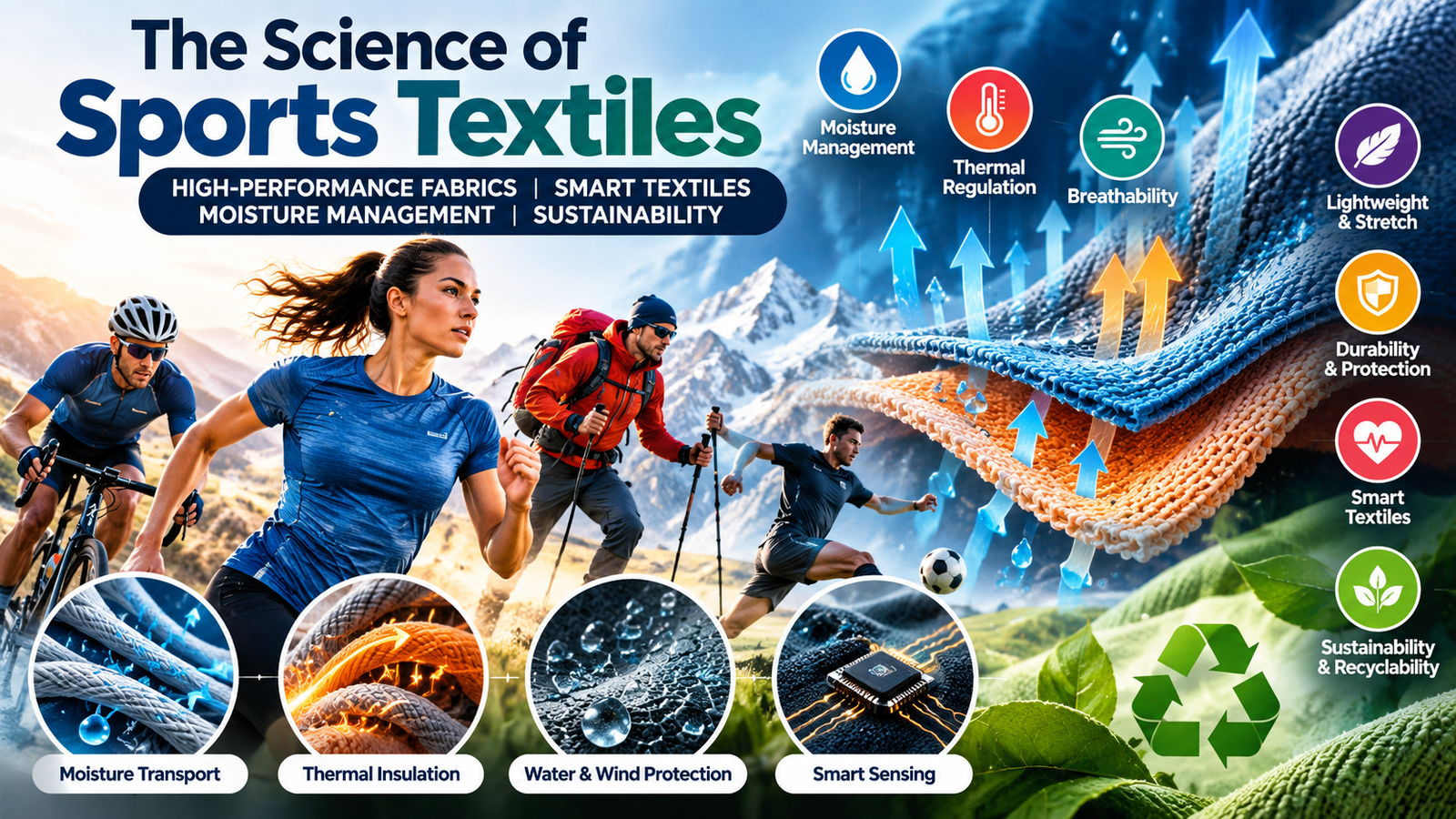
Sportswear is no longer simply clothing designed to cover the body. Modern sports textiles are engineered materials designed to interact with the athlete, the activity and the surrounding environment.
A runner may need rapid sweat transport and cooling. A cyclist may need aerodynamic construction, stretch and low mass. A mountaineer may require thermal insulation, wind resistance and moisture-vapour transport. A football player needs freedom of movement, durability and rapid drying. Meanwhile, smart sportswear is increasingly being developed to monitor physiological signals such as heart rate, body movement and temperature.
1. What Are Sports Textiles?
Sports textiles are textile materials, fabrics, garments and textile-based structures specifically engineered for physical activity, exercise and sporting applications.
They can be designed to provide combinations of:
- Moisture management
- Breathability
- Thermal regulation
- Lightweight construction
- Stretch and recovery
- Abrasion resistance
- UV protection
- Odour control
- Antimicrobial functionality
- Wind and water protection
- Compression and body support
- Impact or cut protection
- Physiological sensing
- Energy harvesting
- Sustainable and recyclable construction
Unlike ordinary apparel, sports textiles are evaluated not only for appearance and comfort but also for their functional interaction with the human body during movement.
Recent research describes this development as a transition from conventional natural and synthetic fibres toward engineered structures, smart materials, sensors, nanotechnology and multifunctional textile systems.
2. Why Do Athletes Need Specialised Textiles?
During exercise, the human body produces metabolic heat. As exercise intensity increases, sweating and blood-flow regulation become important mechanisms for controlling body temperature.
Clothing creates a microclimate between the skin and the environment. Consequently, the properties of the textile can influence:
- Heat transfer
- Sweat transport
- Evaporation
- Skin temperature
- Perceived wetness
- Thermal comfort
- Range of movement
- Post-exercise cooling
This means that the best sports fabric is not necessarily the fabric with the highest moisture absorption or the lowest thermal resistance. Performance depends on the activity, climate, garment design, fibre composition and fabric structure.
A 2026 review specifically emphasises the interaction between fibre composition, fabric structure, garment design and human thermoregulation when evaluating sportswear comfort.
3. How Do Sports Textiles Work?
The performance of sportswear can be understood through the interaction of several textile functions.
Skin → Inner Layer → Functional Layer → Outer Environment
A simplified multilayer sportswear system may contain:
- Inner layer → moves sweat away from the skin
- Functional/insulating layer → manages heat and moisture
- Outer layer → protects against wind, rain or snow while allowing appropriate vapour transfer
This principle is particularly important for outdoor sports and cold-weather clothing.
The objective is not simply to make a garment waterproof or highly insulating. The garment must achieve an appropriate balance between heat retention, moisture transport and environmental protection.
4. Moisture Management: More Than Just “Moisture Wicking”
One of the most important characteristics of active sportswear is its ability to manage perspiration.
The moisture-management process can be considered in three stages:
1. Sweat absorption or collection: Sweat reaches the textile surface from the skin.
2. Liquid transport: Capillary forces move liquid moisture through yarns and fabric pores.
3. Evaporation: Moisture reaches the outer surface and evaporates into the environment.
The overall process is affected by:
- Fibre diameter
- Fibre cross-sectional shape
- Yarn structure
- Fabric porosity
- Fabric thickness
- Fabric density
- Surface energy
- Hydrophilic/hydrophobic balance
- Fabric construction
- Environmental temperature and humidity
Research on active sportswear has shown that moisture transport is strongly influenced by the combination of fibre characteristics and fabric construction rather than fibre type alone.
Why is sweat management important?
If sweat remains close to the skin:
- Skin wetness increases.
- Clothing may feel uncomfortable.
- Evaporative cooling can change.
- Clothing insulation can change.
- In cold environments, wet clothing may increase post-exercise chill.
Therefore, moisture management is a thermal-comfort function as well as a drying function.
5. Does Polyester Always Perform Better Than Natural Fibres?
Not necessarily, polyester is widely used in performance sportswear because it can be engineered for low mass, rapid moisture transport, durability and quick drying.
However, fabric performance and human comfort are not identical concepts.
A 2025 study comparing polyester and modal-blended sportswear during running found that the polyester fabric demonstrated better moisture transfer, while participants reported better comfort with the blended fabric. This illustrates an important point: objective moisture-transfer performance does not automatically translate into superior overall subjective comfort.
Natural fibres can also provide useful performance characteristics. For example, recent research on outdoor sportswear found that wool’s moisture absorption behaviour can influence thermal stability during transient activity and cooling conditions.
6. Thermoregulation: How Sports Textiles Control Heat
Thermoregulation is the ability to manage heat exchange between the human body and its surroundings.
A textile can influence thermal comfort through:
- Thermal resistance
- Thermal conductivity
- Air permeability
- Water-vapour permeability
- Moisture absorption
- Evaporative cooling
- Fabric thickness
- Fabric porosity
- Garment fit
- Layering
- Radiative properties
Recent research into thermoregulating textiles has explored phase-change materials, radiative cooling, thermoelectric systems, shape-memory materials, smart fibres and responsive composites.
Passive versus active thermoregulation:
Passive thermoregulation uses material properties without external power. Examples include:
- Insulating fibres
- Phase-change materials
- Radiative-cooling surfaces
- Moisture-responsive structures
- Engineered multilayer fabrics
Active thermoregulation requires an energy source or active mechanism. Examples include:
- Thermoelectric cooling
- Electrically heated textiles
- Active ventilation
- Electrically controlled smart textiles
The future of sportswear may combine both approaches.
7. Smart Textiles: When Clothing Becomes a Sensor
One of the most exciting developments in sports textiles is the emergence of e-textiles and smart textiles. Traditional wearable devices are often attached to the body as separate electronic devices. E-textiles attempt to integrate sensing and electronic functions directly into textile structures.
Potential measurements include:
- Heart rate
- ECG signals
- Respiration
- Body movement
- Joint motion
- Muscle activity
- Skin temperature
- Pressure
- Strain
- Sweat-related parameters
A study by Yang, K., McErlain-Naylor, S. A., Isaia, B., Callaway, A., & Beeby, S. (2024) review of e-textiles for sports and fitness identified textile-based sensing approaches including inertial measurement units, textile electrodes and piezoresistive sensors, while also discussing challenges related to practical implementation and scaling.
A 2025 review in Nano-Micro Letters further described how smart textiles can integrate sensing functions at the fibre, yarn and fabric levels while retaining textile characteristics such as flexibility and comfort.
8. From Smart Fabric to Personalised Sportswear
The next stage is not simply putting a sensor into a shirt.
Researchers are working toward personalised sportswear systems that can combine:
Textile → Sensor → Data → Analysis → Feedback
For example:
> Athlete exercises → textile sensor detects physiological parameter → signal is transmitted → software analyses the data → athlete/coach receives information.
This could support:
- Training monitoring
- Movement analysis
- Injury-risk assessment
- Rehabilitation
- Performance tracking
- Personalised exercise feedback
However, several challenges remain, particularly washability, durability, power supply, signal reliability, comfort and long-term wearability.
9. Stretch and Flexibility: Why Fabric Construction Matters
Sportswear must move with the body. This is why elastane/spandex and engineered knitted structures are widely used in:
- Running garments
- Cycling apparel
- Compression garments
- Yoga clothing
- Gym wear
- Swimming apparel
- Team sports clothing
Knitted structures are particularly useful because loops can provide substantial extensibility and recovery. However, greater stretch is not automatically better. Excessive stretch can affect:
- Support
- Compression
- Dimensional stability
- Air permeability
- Moisture transport
- Durability
Consequently, sportswear development often requires optimisation of fibre composition + yarn structure + stitch structure + garment pattern.
10. Seamless and Zoned Sportswear
Modern knitting technology allows different regions of the same garment to have different functions.
For example:
| Body zone | Desired function |
| Chest | Thermal regulation |
| Back | Moisture transport |
| Underarm | High breathability |
| Shoulder | Stretch and movement |
| Elbow/knee | Flexibility |
| Waist | Support |
| High-abrasion areas | Durability |
Recent research on seamless winter sportswear demonstrated how bioinspired knitted structures and different yarn combinations can be engineered for thermal-moisture management, water-vapour permeability, wind resistance and odour control.
The study used structures inspired by the veins of the giant water lily and reported substantial differences in moisture-management and thermal properties between engineered and conventional structures.
11. Bioinspired Sports Textiles
Nature provides many models for designing advanced textiles.
Examples include:
- Plant vascular networks → moisture transport
- Lotus leaves → water repellency
- Spider webs → high strength-to-weight structures
- Animal fur → thermal insulation
- Pinecones → humidity-responsive structures
- Human skin → adaptive thermal and moisture management
Bioinspired textiles attempt to reproduce these mechanisms using engineered fibre, yarn and fabric architectures.
The development of water-transport pathways inspired by plant structures is particularly relevant to sportswear because efficient directional liquid transport can help move sweat away from the skin.
12. Breathability and Air Permeability
A common misconception is:
- Waterproof = good sportswear.
For many activities, that is not sufficient.
A high-performance outer layer needs to balance:
Rain protection + wind protection + water-vapour transport + air exchange
Air permeability and water-vapour permeability are therefore important characteristics. The optimal value depends strongly on the application.
For example:
- Winter mountaineering → greater protection
- Indoor running → greater ventilation
- Cycling → aerodynamic and moisture-management balance
- Football → lightweight, breathable and durable construction
- Swimming → very different hydrodynamic requirements
This is why sports textiles should be designed according to activity-specific performance requirements rather than a single universal definition of performance.
13. Thermal Comfort Is Dynamic
Another important development in sports-textile research is the recognition that clothing performance should not always be evaluated under steady-state conditions.
Athletes move through different stages:
Rest → Exercise → High sweating → Reduced activity → Recovery
The thermal behaviour of clothing can change during these transitions.
Research using sweating thermal-manikin experiments has demonstrated differences among wool, polyester, viscose and cotton during simulated outdoor activity and post-exercise cooling. Wool’s moisture-related thermal behaviour was associated with greater thermal stability under the tested conditions.
This supports the need for dynamic sportswear testing, rather than relying exclusively on static measurements.
14. New Generation Moisture-Responsive Textiles
Recent research is moving beyond passive moisture transport. A 2026 study developed a moisture-responsive textile with thermal-management functionality using a hydrophilic polyurethane/hydrophobic polyester dual-layer structure. The material was designed to respond to moisture while maintaining high air permeability and water-vapour transport. Wear trials under hot and humid conditions reported reductions in measured core temperature, skin temperature and heart rate relative to the comparison condition.
This type of research points toward a future in which a textile does not merely transport sweat but responds dynamically to the wearer’s microclimate.
15. Durability: Performance Must Survive Real Use
A sports textile may perform extremely well when new but lose functionality after:
- Washing
- Drying
- UV exposure
- Sweat exposure
- Abrasion
- Stretching
- Repeated compression
- Environmental ageing
A 2025 study examining conventional and recycled polyester sportswear found that environmental ageing altered parameters including thickness, porosity, stiffness, abrasion resistance and wetting/drying behaviour. The recycled polyester samples showed some differences in durability and stiffness compared with conventional polyester.
This is particularly important for smart textiles. A sensor integrated into a sports shirt is useful only if the sensor remains functional after repeated washing and deformation.
16. Sustainable Sports Textiles
The future of sportswear cannot focus exclusively on performance.
It must also consider:
- Fibre origin
- Energy consumption
- Chemical processing
- Dyeing and finishing
- Product lifetime
- Microfibre release
- Recyclability
- End-of-life management
- Recycled content
- Bio-based materials
- Circular manufacturing
Recent research on circular sportswear demonstrates why sustainability needs a life-cycle perspective.
A 2025 life-cycle assessment of a locally manufactured cycling jersey found that energy use was a major environmental-impact driver and that both production- and use-phase changes could reduce environmental impacts. The study also incorporated marine microplastic emissions into the assessment.
Therefore, a recycled fibre is not automatically equivalent to a sustainable garment. The complete product life cycle needs to be considered.
17. Recycled Polyester in Sportswear
Recycled PET is increasingly relevant to sportswear because polyester is widely used in performance apparel.
Potential advantages include:
- Reduced dependence on virgin petroleum feedstocks
- Utilisation of post-consumer material
- Potential resource savings
- Compatibility with existing polyester textile technologies
However, recycled fibres must still be evaluated for:
- Mechanical performance
- Thermal properties
- Moisture management
- Abrasion resistance
- Colour fastness
- Durability
- Microfibre emissions
- End-of-life recyclability
The recent research on recycled and conventional polyester sportswear demonstrates why performance must be evaluated throughout the product’s service life, not only immediately after manufacturing.
18. Key Performance Parameters for Sports Textiles
A comprehensive sportswear evaluation can include the following parameters:
| Category | Important parameters |
| Thermal | Thermal resistance, thermal conductivity, thermal absorptivity |
| Moisture | Wicking, absorption, spreading, drying rate |
| Vapour | Water-vapour permeability, evaporative resistance |
| Air | Air permeability, ventilation |
| Mechanical | Tensile strength, tear strength, bursting strength |
| Stretch | Elongation, recovery, compression |
| Durability | Abrasion, pilling, laundering resistance |
| Surface | Contact angle, wettability, friction |
| Protection | UV, wind, rain, cut/abrasion protection |
| Comfort | Skin sensation, thermal sensation, wetness perception |
| Smart functions | Sensor sensitivity, signal stability, wash durability |
| Sustainability | Recycled content, LCA, energy, water, microfibres |
19. How Are Sports Textiles Tested?
Laboratory testing is essential because subjective comfort alone cannot explain all textile-performance characteristics.
Important measurements can include:
Thermal properties:
- Thermal resistance
- Thermal conductivity
- Thermal diffusivity
- Thermal absorptivity
Moisture properties:
- Vertical wicking
- Horizontal wicking
- Moisture Management Tester (MMT) parameters
- Drying rate
- Water-vapour permeability
Physiological comfort:
- Skin temperature
- Core temperature
- Sweat rate
- Heart rate
- Perceived exertion
- Thermal sensation
- Wetness sensation
Instrumented evaluation:
Modern sportswear research increasingly combines:
Textile laboratory testing + thermal manikins + climate chambers + human wear trials + sensors + data analysis
The 2026 review of sportswear thermophysiological comfort specifically highlights the importance of combining laboratory testing, wear trials and data-driven approaches when assessing personalised comfort.
20. Sports Textiles and the Future of Athlete Performance
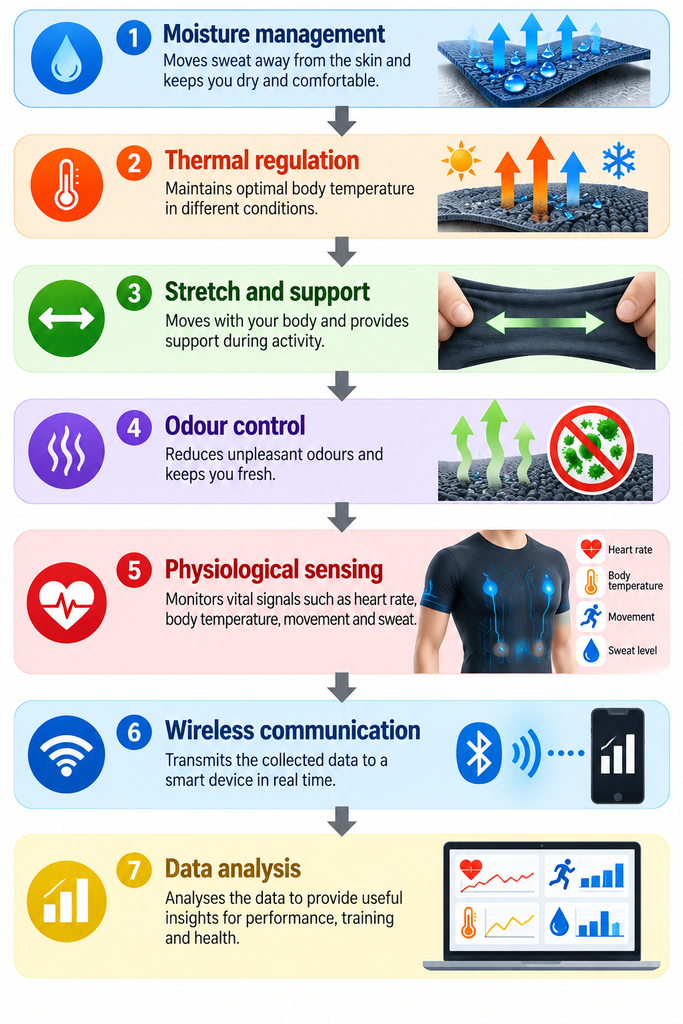
The future sports garment is likely to become increasingly multifunctional.
A single garment could potentially combine:
Moisture management
↓
Thermal regulation
↓
Stretch and support
↓
Odour control
↓
Physiological sensing
↓
Wireless communication
↓
Data analysis
Recent reviews describe this convergence of textile engineering, smart sensors, nanomaterials, wearable electronics and artificial intelligence as an important direction for sportswear development.
However, innovation must still satisfy fundamental textile requirements:
Comfort + durability + washability + safety + affordability + sustainability.
21. The Future: From Fibre to Smart Athlete
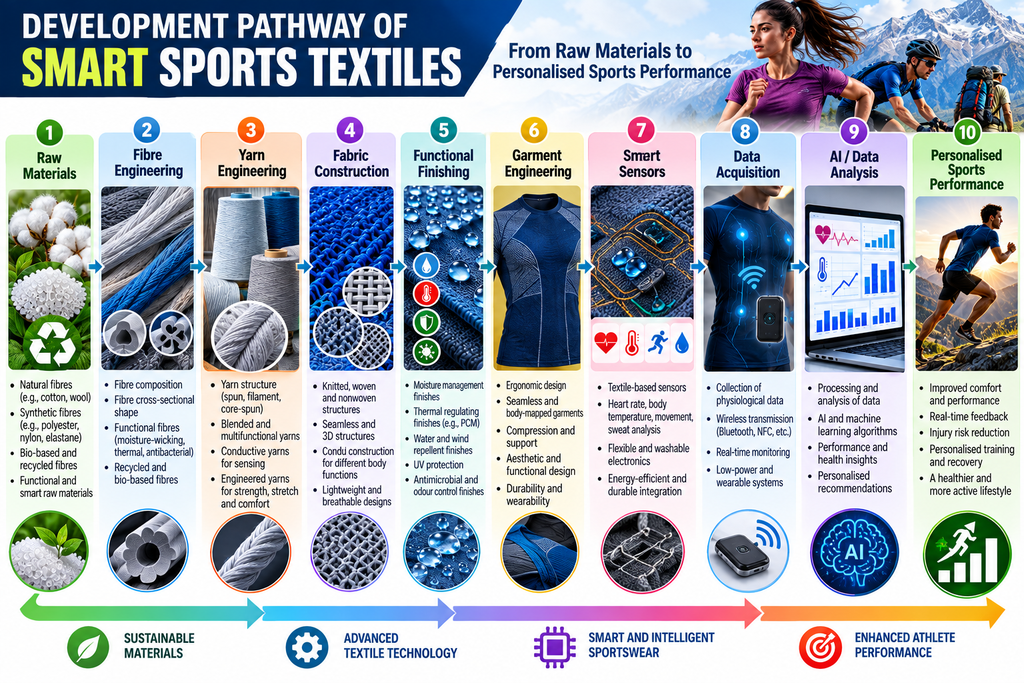
The development pathway can be visualised as:
Raw Materials
↓
Fibre Engineering
↓
Yarn Engineering
↓
Fabric Construction
↓
Functional Finishing
↓
Garment Engineering
↓
Smart Sensors
↓
Data Acquisition
↓
AI/Data Analysis
↓
Personalised Sports Performance
This represents the transformation of sports textiles from passive materials into interactive human–textile systems.
22. Major Trends in Sports Textiles for 2026 and Beyond
Based on recent research, several important directions are emerging.
1. Smart sportswear: Textiles increasingly incorporate sensors for physiological and biomechanical monitoring.
2. Adaptive thermoregulation: Research is moving toward textiles that respond to temperature, humidity or moisture.
3. Bioinspired structures: Plant- and nature-inspired architectures are being investigated for improved liquid transport and thermal-moisture management.
4. Personalised comfort: Researchers are increasingly considering individual physiology, activity and environmental conditions rather than designing one fabric for everyone.
5. Sustainable performance fibres: Recycled, bio-based and recyclable materials are becoming increasingly important in sportswear development.
6. Multifunctional fabrics: Future sportswear is expected to combine several functions within one textile system rather than relying on separate layers or treatments.
7. Longer-lasting performance: Durability, washability and retention of functionality are becoming critical performance criteria, particularly for smart and sustainable textiles.
Conclusion
Sports textiles represent one of the most dynamic areas of modern textile engineering. The field has evolved from simple sweat-absorbing and stretch fabrics toward sophisticated materials capable of moisture transport, thermal regulation, protection, responsive behaviour and physiological sensing.
The latest research indicates that the future will not be defined by a single “super fibre.” Instead, performance will come from the engineering of complete textile systems—from fibre and yarn through fabric architecture, finishing, garment design and smart functionality.
At the same time, sustainability is becoming inseparable from performance. Future sportswear must not only help athletes move better and feel more comfortable, but also provide longer service life, reduced environmental impact and pathways toward circularity.
The ultimate goal is therefore not simply “Better sportswear.” It is: “Smarter, more comfortable, more durable and more sustainable textile systems for human performance.”
Frequently Asked Questions
What are sports textiles?
Sports textiles are engineered textile materials designed for athletic and physical activities. They may provide moisture management, thermal regulation, stretch, durability, protection, compression, odour control and smart sensing.
What is moisture-wicking fabric?
Moisture-wicking fabric is designed to transport liquid sweat away from the skin through capillary action and distribute it over a larger surface area, facilitating evaporation.
Which fibre is best for sportswear?
There is no universally best fibre. Polyester, nylon, elastane, polypropylene, wool, modal and fibre blends can each provide different combinations of moisture management, thermal comfort, durability, stretch and tactile comfort.
Why is polyester widely used in sportswear?
Polyester can provide low mass, durability, rapid drying and engineered moisture transport. Its performance depends strongly on fibre geometry, yarn construction and fabric structure.
What are smart textiles in sports?
Smart textiles are textile-based systems that incorporate sensing, electronic, responsive or data-communication functions. They can potentially monitor physiological and biomechanical parameters during exercise.
What is thermoregulating sportswear?
Thermoregulating sportswear is designed to manage heat transfer between the body and environment. Technologies include insulation, phase-change materials, radiative cooling, moisture-responsive structures and active thermal systems.
Are sustainable sports textiles as effective as conventional sportswear?
Performance depends on the specific material and construction. Recycled and bio-based materials can provide useful performance, but durability, moisture management, environmental impact and end-of-life behaviour must be evaluated together.
References:
1. Abedin, F., Deaton, A. S., & DenHartog, E. (2025). Thermal dynamics of textile fibers: Enhancing outdoor comfort through exothermic and endothermic interactions. The Journal of The Textile Institute, 116(11), 2568–2577. https://doi.org/10.1080/00405000.2024.2444706
2. Chan, W. S., Shi, G. Q. Q., Lau, K., & Chow, D. H. K. (2025). Evaluating the impact of sportswear with different fabric properties on comfort and physiological response during running. International Journal of Fashion Design, Technology and Education, 18(2), 190–198. https://doi.org/10.1080/17543266.2024.2347299
3. Cui, G., & Wang, C. (2025). Applications and development trends of textile materials in sports: A review. Alexandria Engineering Journal, 126, 491–506. https://doi.org/10.1016/j.aej.2025.04.094
4. Farhana, K., & Akhtar, M. (2026). A comprehensive technical review of the thermo-physiological comfort levels of sportswear. Intelligent Sports and Health, 2(3), 188–223. https://doi.org/10.1016/j.ish.2026.06.002
5. Islam, M. T., Hosen, M. I., Islam, T., Al Mamun, M. A., & Islam, T. (2025). Advancements in functional smart and wearable textiles for sportswear applications. RSC Advances, 15(58), 50206–50232. https://doi.org/10.1039/D5RA07231J
6. Pellengahr, F., Ghannadzadeh, A., & van der Meer, Y. (2025). Advancing sustainability of textiles: A life cycle and microfiber emission assessment of locally manufactured circular sportswear. Environmental Sciences Europe, 37, 175. https://doi.org/10.1186/s12302-025-01204-8
7. Salopek Čubrić, I., Petrov, A., & Čubrić, G. (2025). Evaluating the impact of environmental exposure on the performance of polyester sportswear materials. Polymers, 17(12), 1616. https://doi.org/10.3390/polym17121616
8. Tang, K. H. D. (2025). Advances in thermoregulating textiles: Materials, mechanisms, and applications. Textiles, 5(2), 22. https://doi.org/10.3390/textiles5020022
9. Wan, A., Teng, Y., & Cong, H. (2026). Thermal-moisture management and deodorization performance of winter seamless sportswear based on bioinspired structure. The Journal of The Textile Institute, 117(5), 883–895. https://doi.org/10.1080/00405000.2025.2535925
10. Xu, Z., Zhang, C., Wang, F., Yu, J., Yang, G., Surmenev, R. A., Li, Z., & Ding, B. (2025). Smart textiles for personalized sports and healthcare. Nano-Micro Letters, 17, 232. https://doi.org/10.1007/s40820-025-01749-6
11. Yang, K., McErlain-Naylor, S. A., Isaia, B., Callaway, A., & Beeby, S. (2024). E-textiles for sports and fitness sensing: Current state, challenges, and future opportunities. Sensors, 24(4), 1058. https://doi.org/10.3390/s24041058
12. Yang, W., Deng, J., Wei, S., & Zhang, C. (2026). Preparation of durable, intelligent moisture-sensitive textile with thermal management capability. Case Studies in Thermal Engineering, 82, 108150. https://doi.org/10.1016/j.csite.2026.108150
Read More
- Essential Nanofibers for Medical Uses: Types and Breakthroughs
- ASTM Standards in Textile and Apparel Sectors
- Spun Spinning: Process Sequence and Material Flow
- From Waste to Wearables: The Evolution of Acoustic Textiles
- ntroduction to Weaving and Shuttle Looms
- Handloom to High Street: Why Traditional Textiles Matter Today
- Lean Manufacturing Tools in the Textile & Apparel Industry
- CO₂ vs Water Dyeing: A Sustainable Comparison
- The Rise of Sustainable Textile Insulation Materials
- Innovations in Smart Textiles for Wearable Comfort
- Recent Advancements in Weaving Technology
- Wyzenbeek vs Martindale: Fabric Test Comparison
- Differences Between SAM and SMV in Garment Manufacturing
- Exploring the Future: Smart Textiles and Their Influence on Technological Innovation
- China’s Cotton Topping Robot: Revolutionizing Xinjiang’s Fields at 10x Speed
- Smart Garments for Elderly Health Monitoring and Active Living