
Introduction
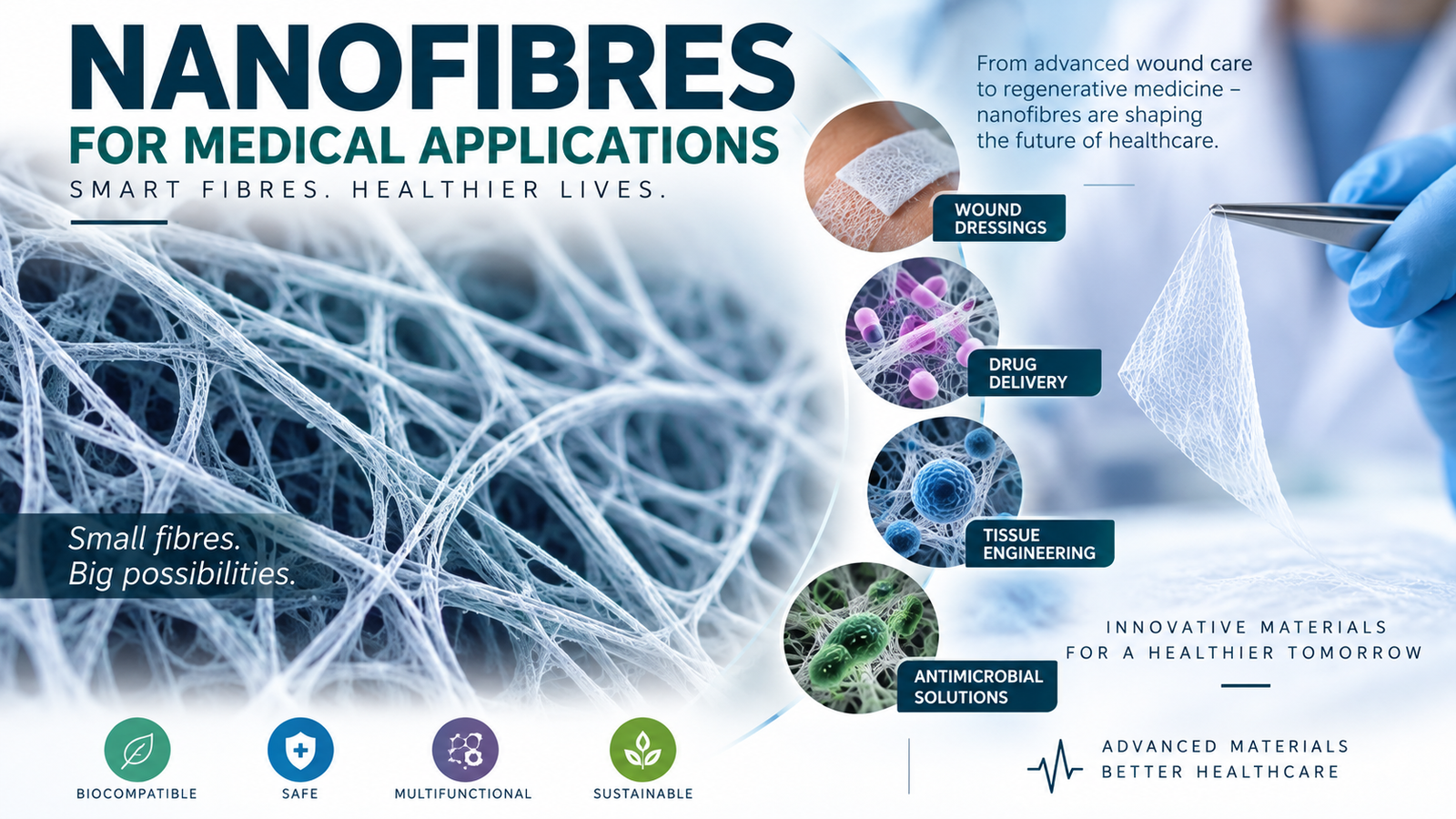
Nanofibres for medical applications have emerged as a promising area of advanced textile and biomaterials research. Their extremely small fiber diameter, high surface-area-to-volume ratio, interconnected porosity, and flexibility enable delivery, wound care, and tissue engineering. They also support regenerative medicine and biosensing.
Unlike conventional textile fibers, nanofibres can be engineered to reproduce some of the structural characteristics of the extracellular matrix (ECM) surrounding cells. This makes them particularly attractive for biomedical scaffolds and advanced wound-care materials. Recent research has also moved beyond simple nanofibre mats toward multifunctional, multilayered, coaxial and stimuli-responsive structures capable of delivering drugs and biological signals in a controlled manner.
The growing interest in nanofibres is therefore closely connected with the development of advanced medical textiles, smart wound dressings, regenerative scaffolds and targeted drug-delivery systems.
What Are Nanofibres?
Nanofibres are extremely fine fibers generally having diameters in the nanometer range. In biomedical research, electrospun fibers commonly have diameters from tens to several hundreds of nanometers, depending on the polymer, solvent system and processing conditions.
At this scale, fibers can form highly porous, interconnected networks. The resulting structure provides:
- Very high specific surface area
- High porosity
- Controlled pore size
- Good flexibility
- Large surface area for drug loading
- Possibility of surface functionalisation
- Tunable degradation behavior
- Structural similarity to components of the extracellular matrix
Recent research describes electrospun nanofibres as particularly attractive because their architecture can be adjusted to support cell attachment, proliferation, migration and tissue regeneration.
For medical textiles, these characteristics are important because the material must do more than simply cover or protect a biological surface. It may need to absorb wound exudate, maintain an appropriate moist environment, prevent microbial contamination, deliver therapeutic substances and support tissue regeneration.
Why Are Nanofibres Important in Medical Textiles?
Conventional medical fibers already provide important functions such as absorbency, liquid transport, strength and flexibility. Your presentation highlights the importance of these characteristics in wound dressings, hygiene products and other healthcare textiles. Nanofibres introduce an additional level of structural control. A nanofibrous membrane can be designed so that its:
fiber diameter → porosity → surface area → wettability → drug loading → degradation rate → biological response; are interconnected and controlled during material development.
This makes nanofibres useful for designing medical materials with application-specific performance rather than relying only on the inherent properties of the base fiber.
Materials Used to Produce Medical Nanofibres
Medical nanofibres can be manufactured from both natural and synthetic polymers
Natural polymers
Important natural or biologically derived materials include:
- Collagen
- Chitosan
- Alginate
- Gelatin
- Silk fibroin
- Keratin
- Cellulose and cellulose nanocrystals
- Hyaluronic acid
- Other protein- and polysaccharide-based biomaterials
These materials are attractive because many possess biological functionalities and can provide favorable cell–material interactions. Alginate can absorb wound exudate and form a gel-like environment, while chitosan is associated with wound healing, tissue adhesion and antimicrobial behavior. Collagen is particularly relevant because of its biological similarity to native connective tissue.
Synthetic polymers
Common synthetic polymers include:
- Poly(lactic acid) (PLA)
- Polycaprolactone (PCL)
- Poly(glycolic acid) (PGA)
- Polyvinyl alcohol (PVA)
- Polyurethane (PU)
- Polyethylene oxide (PEO)
- Poly(lactic-co-glycolic acid) (PLGA)
Synthetic polymers provide greater control over mechanical properties, degradation rate, processing behavior and reproducibility. PLA electrospun nanofibres, for example, are being investigated for tissue engineering, controlled drug release and disposable medical products.
The Major Manufacturing Technique
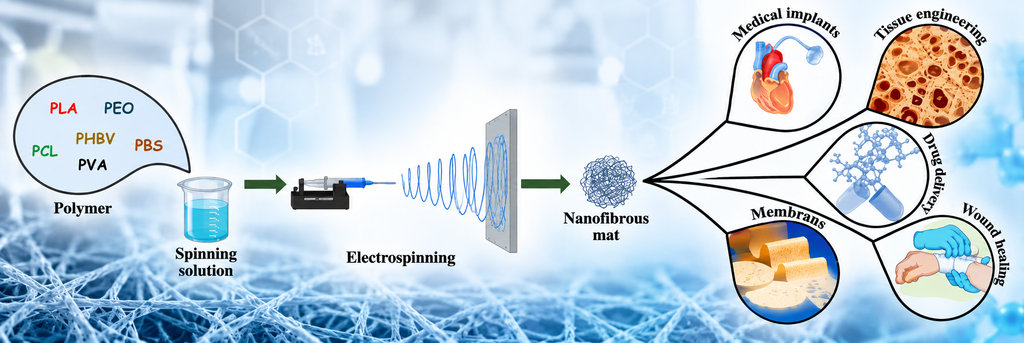
Electrospinning is currently one of the most widely investigated techniques for producing polymeric nanofibres. A conventional electrospinning system consists of:
- Polymer solution or melt
- Syringe or feed system
- Spinneret or needle
- High-voltage power supply
- Collector
A high electric field is applied between the spinneret and collector. When the electrostatic force overcomes the surface tension of the polymer solution, a charged liquid jet is generated. As the jet travels toward the collector, the solvent evaporates and a fine polymer fiber is deposited. The process can produce continuous fibers with nanoscale diameters. Recent research confirms that fiber morphology is influenced by parameters such as polymer concentration, molecular weight, viscosity, applied voltage, flow rate, tip-to-collector distance, temperature and humidity. Therefore, electrospinning is not simply a fiber-production technique; it is a process for engineering the architecture and functionality of biomedical materials.
Types of Electrospinning for Medical Applications
1. Conventional electrospinning
Single-fluid electrospinning is the simplest approach and is widely used to produce nanofibrous membranes. It is suitable for wound dressings, tissue-engineering scaffolds and drug-loaded membranes.
2. Coaxial electrospinning
Coaxial electrospinning uses two concentric fluid streams to produce core–shell nanofibres. This architecture is particularly useful when a drug, protein or other bioactive compound must be protected inside the fiber. It can also provide better control over drug release than a simple blend fiber. Recent research identifies coaxial electrospinning as an important direction for precision wound dressings and sustained therapeutic delivery.
3. Emulsion electrospinning
Emulsion electrospinning can encapsulate bioactive compounds within nanofibres and is useful for controlled drug delivery.
4. Needleless and scalable electrospinning
Conventional needle-based electrospinning can have limitations in productivity. Needleless, multi-needle, rotary and other high-throughput systems are therefore being investigated for commercial-scale production. Scalability remains one of the major challenges in transferring electrospun nanofibres from laboratory research to medical products.
Application of Nanofibres
Nanofibres for Wound Dressings
One of the most important applications of nanofibres is advanced wound care. Nanofibres for Medical Applications guide the design of effective dressings. An ideal wound dressing should protect the wound, absorb exudate, and maintain moisture. It must permit gas exchange and minimize bacterial contamination while supporting tissue regeneration. Nanofibrous membranes can address several of these requirements simultaneously.
Their high porosity supports oxygen and moisture transport, while the high surface area provides opportunities for incorporating antimicrobial agents, drugs, peptides, growth factors and other bioactive molecules.
Recent research has investigated nanofibres containing:
- Antibiotics
- Antibacterial peptides
- Silver and other metal ions
- Metal and inorganic nanoparticles
- Plant-derived compounds
- Growth factors
- Anti-inflammatory drugs
- Antioxidants
A review by Topuz, F., & Uyar, T. (2025) specifically highlights the ability of antibacterial electrospun nanofibres to combine antimicrobial defense with cellular adhesion, proliferation and tissue regeneration.
Smart and Multifunctional Wound Dressings
The development of nanofibres is increasingly moving from passive wound coverage toward smart wound dressings. A multifunctional nanofibre dressing may combine several functions in a single structure:
Protection + moisture management + antimicrobial activity + drug delivery + tissue regeneration + sensing
For example, a multilayered nanofibre structure can be designed with an outer protective layer and an inner therapeutic layer.
Stimuli-responsive systems are another emerging area. In these systems, drug release can respond to environmental factors such as:
- pH
- Temperature
- Enzymatic activity
- Moisture
- Reactive oxygen species
Such systems could potentially provide more controlled treatment of complex or chronic wounds. Recent reviews also identify real-time wound monitoring and biophysical stimulation as emerging directions in nanofibre-based smart dressings.
Nanofibres for Drug Delivery
The high surface area and tunable structure of nanofibres make them attractive drug-delivery systems. Drugs can be incorporated into nanofibres by:
- Direct blending
- Surface loading
- Encapsulation
- Core–shell structures
- Nanoparticle incorporation
- Layer-by-layer structures
The release profile can be modified by controlling fiber diameter, polymer degradation, drug distribution and fiber architecture. This is particularly useful when local drug delivery is preferred over systemic administration. For example, an electrospun membrane placed directly on a wound could gradually release an antimicrobial or anti-inflammatory compound at the treatment site.
Recent studies have also investigated nanofibres containing advanced drug carriers. One 2025 study developed a chitosan–PCL electrospun membrane incorporating a lanthanum-based metal–organic framework for pH-responsive doxorubicin delivery. This illustrates how nanofibres can serve as a structural platform for combining multiple levels of drug-delivery technology.
Nanofibres in Tissue Engineering
Tissue engineering aims to repair, replace or regenerate damaged tissues. A major challenge is developing a scaffold that provides appropriate physical and biological signals to cells. Nanofibrous scaffolds can partially reproduce the fibrous architecture of the extracellular matrix. Nanofibres for Medical Applications guide scaffold design.
Their fiber orientation, diameter, porosity, stiffness, degradation and surface chemistry can be modified according to the target tissue.
Potential applications include:
- Skin regeneration
- Bone regeneration
- Cartilage regeneration
- Nerve regeneration
- Muscle tissue engineering
- Vascular tissue engineering
- Tendon and ligament regeneration
Recent research particularly emphasises the use of biopolymer-based electrospun nanofibres for wound healing, bone regeneration, tissue engineering and protein or peptide delivery. Collagen and chitosan nanofibres are also being extensively investigated because these materials combine biological functionality with the ability to form electrospun fibrous structures.
Nanofibres for Biosensors and Wearable Healthcare
Another rapidly developing field is the use of nanofibres in biosensors and wearable medical systems. Their high surface area allows functional molecules, enzymes, nanoparticles or conductive materials to be incorporated into the fibrous structure.
Potential applications include monitoring:
- Glucose
- pH
- Temperature
- Biomarkers
- Wound status
- Infection-related changes
- Physiological signals
Electrospinning can also be combined with conductive materials and flexible substrates to create wearable sensing platforms. This represents an important connection between medical textiles, nanotechnology and smart textiles.
Sustainable and Biologically Compatible Nanofibres
Natural Polymer
Natural polymers are particularly important for developing sustainable and biologically compatible nanofibres.
Chitosan
Chitosan is derived from chitin and has attracted significant interest for wound healing and drug delivery. Its biological activity and ability to interact with cells make it useful in biomedical nanofibre systems.
Collagen
Collagen is a major structural protein in biological tissues. Collagen-based nanofibres can provide biologically relevant cues for cell adhesion and tissue regeneration.
Cellulose nanocrystals
Cellulose nanocrystals (CNCs) are increasingly being incorporated into electrospun structures to improve mechanical properties and provide sustainable biomaterial platforms.
A review by Ahmed, S., Khan, R A., Rashid, T U. (2025) reports applications of CNC-based electrospun nanofibres in drug delivery, wound healing, tissue engineering and biosensing, while also highlighting their biodegradability, cytocompatibility and mechanical potential.
PLA and PCL
Synthetic biodegradable polymers remain equally important. PLA offers biodegradability and is widely investigated for tissue engineering and drug-release systems. PCL degrades more slowly than many other biodegradable polymers and can therefore be useful where longer-term structural support is required.
The degradation behavior of resorbable polymers is strongly related to polymer chemistry, crystallinity, molecular weight, morphology and environmental conditions. Your presentation similarly identifies PLA, PGA, PDO and PCL among important resorbable fiber materials and notes that crystalline and amorphous regions influence degradation and resorption.
Antibacterial Nanofibres
Bacterial infection is one of the major complications associated with wounds and implanted medical materials. Nanofibres provide a convenient platform for incorporating antimicrobial agents without necessarily changing the overall fibrous architecture.
Researchers are investigating:
- Silver nanoparticles
- Copper and zinc-based systems
- Antibiotics
- Antimicrobial peptides
- Essential oils
- Plant extracts
- Photothermal agents
- Photodynamic agents
The challenge is to obtain sufficient antimicrobial activity without causing toxicity to healthy cells. Therefore, cytotoxicity, antimicrobial effectiveness and controlled release must be evaluated together rather than considering antibacterial activity alone.
Advantages of Nanofibres for Medical Applications
The major advantages can be summarised as follows:
| Property | Medical significance |
| High surface area | High drug and bioactive loading potential |
| High porosity | Moisture and gas exchange |
| ECM-like structure | Supports cell attachment and regeneration |
| Tunable fibre diameter | Controls surface and biological interactions |
| Biodegradability | Useful for temporary scaffolds |
| Flexibility | Suitable for wound and wearable applications |
| Surface functionalisation | Enables targeted biological functions |
| Controlled drug release | Supports localised therapy |
| Composite formation | Allows multiple functions in one material |
| Structural tunability | Enables application-specific designs |
Challenges and Limitations
Despite their potential, nanofibres are not yet a universal solution for medical applications.
1. Scale-up
Laboratory electrospinning often produces relatively small quantities. Industrial production requires high-throughput and reproducible manufacturing.
2. Solvent toxicity
Many electrospinning systems use organic solvents. Residual solvent can create safety and biocompatibility concerns. Recent research therefore emphasises greener electrospinning approaches.
3. Mechanical strength
Very thin nanofibrous membranes may not provide sufficient mechanical strength for load-bearing applications.
4. Sterilisation
Medical materials must withstand appropriate sterilisation without losing their structure or therapeutic functionality.
5. Drug-release control
Achieving predictable release over the required treatment period remains challenging, especially for complex biologics.
6. Regulatory translation
Excellent laboratory performance does not automatically mean clinical success. Long-term biocompatibility, toxicity, reproducibility, sterilisation, manufacturing quality and regulatory requirements must all be addressed.
Future of Nanofibres in Medical Applications
The future of medical nanofibres is moving toward multifunctional and personalised biomaterials rather than simple fiber membranes.
Important research directions include:
- 3D nanofibrous scaffolds for improved tissue regeneration
- Coaxial nanofibres for controlled and sequential drug delivery
- Stimuli-responsive nanofibres for intelligent therapy
- Conductive nanofibres for neural and electronic biomedical applications
- Antimicrobial nanofibres for infection-resistant wound care
- Bioactive nanofibres containing growth factors and peptides
- Sustainable nanofibres based on cellulose and other renewable polymers
- 3D printing combined with electrospinning for hierarchical scaffolds
- Microfluidic-assisted fiber production for precision biomaterials
- Smart wearable nanofibre systems for continuous health monitoring
Recent research is already exploring combinations of electrospinning with 3D printing, microfluidics and other advanced manufacturing technologies to improve scalability and enable personalised biomedical structures.
Conclusion
Nanofibres for medical applications represent an important convergence of textile science, polymer engineering, nanotechnology and biomedical engineering.
Their unique combination of high surface area, porosity, flexibility, tunable architecture and functionalisation capability makes them particularly valuable for advanced wound dressings, drug delivery, tissue engineering, regenerative medicine, antibacterial materials and biosensing.
The transition from conventional medical textiles to nanofibre-based systems is especially significant because the fiber structure can be engineered at a scale comparable to biological structures. Natural polymers such as chitosan, collagen and cellulose can provide biological functionality, while synthetic polymers such as PLA and PCL offer control over mechanical and degradation properties.
The next generation of medical nanofibres is likely to be increasingly multifunctional, biodegradable, intelligent and patient-specific. However, successful clinical translation will depend not only on laboratory performance but also on scalable manufacturing, sterilisation, safety, reproducibility and regulatory validation.
For textile and medical-textile researchers, nanofibre technology therefore represents a promising platform for developing the next generation of smart, functional and regenerative healthcare materials.
References
- Patel, D. K., Won, S.-Y., Jung, E., & Han, S. S. (2025). Recent progress in biopolymer-based electrospun nanofibers and their potential biomedical applications: A review. International Journal of Biological Macromolecules, 293, 139426. https://doi.org/10.1016/j.ijbiomac.2024.139426
- Ramakrishnan, P., Ramprasath, R., Jalaludeen, A. M., Jayakumar, R., Jolius, G., Balu, R., et al. (2025). Electrospun nanofibers of collagen and chitosan for tissue engineering and drug delivery applications: A review. International Journal of Biological Macromolecules, 139663. https://doi.org/10.1016/j.ijbiomac.2025.139663
- Zhao, J., Chen, L., et al. (2024). Recent advances in coaxial electrospun nanofibers for wound healing. Materials Today Bio, 29, 101309. https://doi.org/10.1016/j.mtbio.2024.101309
- Wang, Q., Ji, P., Bu, T., Mao, Y., He, H., & Ge, N. (2025). Recent Progress in the Application of Electrospinning Technology in the Biomedical Field. Journal of Functional Biomaterials, 16(7), 266. https://doi.org/10.3390/jfb16070266
- Pan, X., Jiang, Q., Zhong, Y., Cui, P., Hao, W., & Yang, W. (2025). Biomedical applications of poly(lactic acid) electrospun nanofibers: A review. International Journal of Biological Macromolecules, 322(Pt 4), 146977. https://doi.org/10.1016/j.ijbiomac.2025.146977
- Ahmed, S., Khan, R A., Rashid, T U. (2025). Cellulose nanocrystal based electrospun nanofiber for biomedical applications–A review. Carbohydrate Polymers, 348, 122838. https://doi.org/10.1016/j.carbpol.2024.122838
- Anbazhagan, M. K., & Mahalingam, S. (2025). Advancements in nanofibers and nanocomposites: Cutting-edge innovations for tissue engineering and drug delivery—A review. Science Progress, 108(2), 368504241300842. https://doi.org/10.1177/00368504241300842
- Topuz, F., & Uyar, T. (2025). Antibacterial electrospun nanofibers for wound dressing applications. Current Opinion in Biomedical Engineering, 36, 100616. https://doi.org/10.1016/j.cobme.2025.100616
- Shariatzadeh, F J., Currie, S,, Logsetty, S., Spiwak, R., Liu, S. (2025). Enhancing wound healing and minimizing scarring: A comprehensive review of nanofiber technology in wound dressings.. Progress in Materials Science, 147, 101350. https://doi.org/10.1016/j.pmatsci.2024.101350
- Lv, H., Wang, S., He, M., Zhu, X., He, P., Sun, R., et al. (2025). Electrospun SF/PHBV nanofibers loaded with berberine as a bioactive wound dressing: Accelerating diabetic wound healing and alleviating hypertrophic scar. Materials & Design, 251, 113574. https://doi.org/10.1016/j.matdes.2024.113574
- Kumar V, Naqvi S, Gopinath P. Chapter 7 – applications of nanofibers in tissue engineering. In: Mohan Bhagyaraj S, Oluwafemi OS, Kalarikkal N, Thomas N (eds) Micro and nano technologies. New Delhi: Woodhead Publishing, 2018, pp.179–203. https://doi.org/10.1016/B978-0-08-101971-9.00008-9
Read More
- ASTM Standards in Textile and Apparel Sectors
- Spun Spinning: Process Sequence and Material Flow
- From Waste to Wearables: The Evolution of Acoustic Textiles
- ntroduction to Weaving and Shuttle Looms
- Handloom to High Street: Why Traditional Textiles Matter Today
- Lean Manufacturing Tools in the Textile & Apparel Industry
- CO₂ vs Water Dyeing: A Sustainable Comparison
- The Rise of Sustainable Textile Insulation Materials
- Innovations in Smart Textiles for Wearable Comfort
- Recent Advancements in Weaving Technology
- Wyzenbeek vs Martindale: Fabric Test Comparison
- Differences Between SAM and SMV in Garment Manufacturing
- Exploring the Future: Smart Textiles and Their Influence on Technological Innovation
- China’s Cotton Topping Robot: Revolutionizing Xinjiang’s Fields at 10x Speed
- Smart Garments for Elderly Health Monitoring and Active Living