Introduction:
Noise pollution has escalated into one of the most pervasive environmental challenges of the 21st century. Rapid urbanisation, the densification of transport networks, and industrial expansion have subjected populations to chronic exposure to unwanted sound. Beyond mere annoyance, prolonged noise exposure is linked to severe health outcomes, including sleep disturbance, cardiovascular stress, and reduced cognitive productivity. In this landscape, acoustic textiles have emerged not just as aesthetic interior elements, but as high-performance, engineered solutions capable of mitigating noise through advanced absorption and insulation mechanisms.
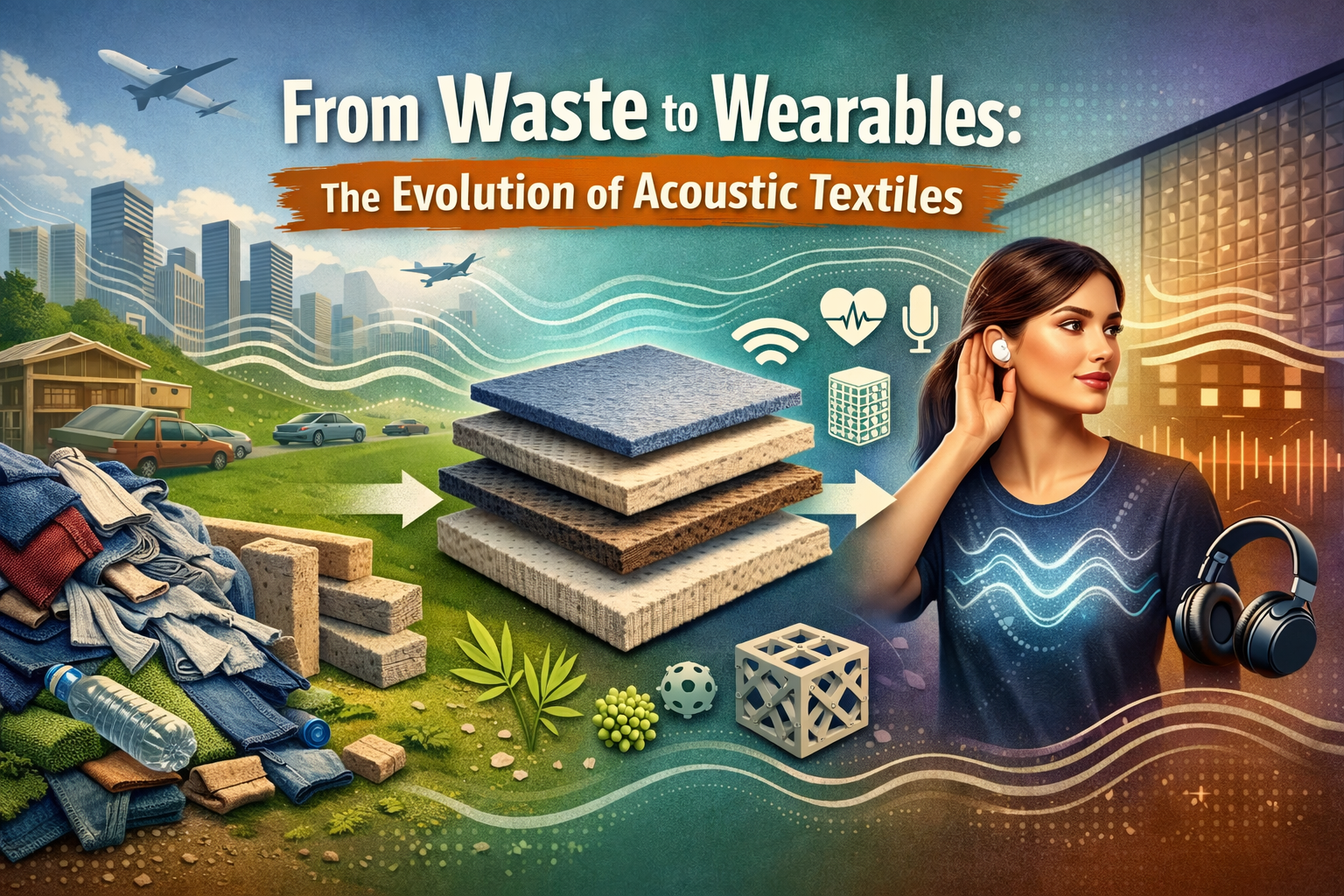
While traditional acoustic treatments often rely on synthetic foams or mineral wools, recent research emphasises the role of textile structures ranging from recycled garment waste to futuristic “smart” fabrics in creating sustainable and functional acoustic environments. This article provides an educational and technical overview of acoustic textiles, integrating fundamental principles with cutting-edge research from 2020 and 2026.
Principles of Sound Absorbers:
To understand how textiles control noise, one must first grasp the interaction between sound waves and porous media. Sound propagates as pressure waves; when these waves encounter a textile boundary, the energy is either reflected, transmitted, or absorbed. The primary metric for this performance is the Sound Absorption Coefficient (SAC), which ranges from 0 (total reflection) to 1 (total absorption).
1. Mechanisms of Sound Absorption
Textile acoustic materials generally function as porous absorbers. They contain an intricate network of interconnected voids and channels. As sound waves penetrate this “tortuous” pore network, the air molecules are forced to oscillate within the narrow passages.
- Viscous Losses: The friction between the oscillating air molecules and the pore walls converts acoustic energy into heat.
- Thermal Losses: Heat exchange between the air and the fibres further dissipates energy.
Research on polypropylene (PP) nonwovens confirms that viscous resistance is the dominant mechanism for mid- to high-frequency absorption. For lower frequencies, resonant absorbers (such as membrane or panel absorbers) are often required, which vibrate to dissipate energy at specific tuned frequencies.
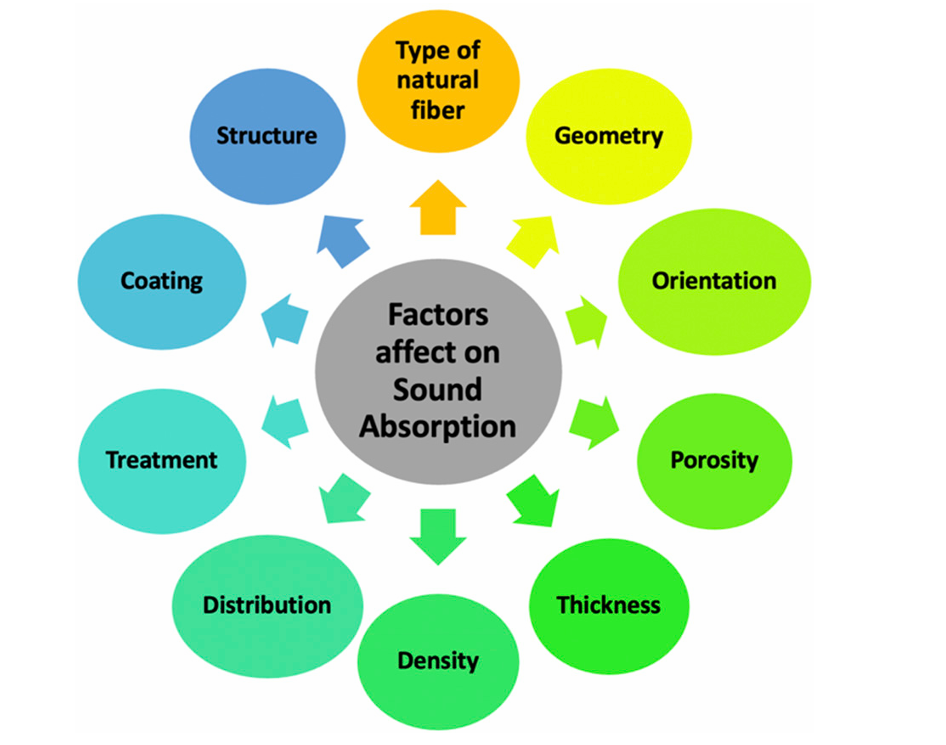
2. Factors Affecting Performance
Fibre Type & Properties
- Different fibres (kenaf, jute, hemp, flax, coir, cotton, etc.) vary in density, stiffness, porosity, and chemical composition.
- Fibres with higher porosity and lower stiffness tend to absorb high-frequency sounds better, while denser fibres are more effective at low frequencies.
Geometrical Characteristics
- Fibre length, diameter, and aspect ratio (length-to-diameter) strongly influence acoustic behaviour.
- Cross-sectional shape and lumen size affect how sound waves penetrate and dissipate.
Orientation & Distribution
- Randomly oriented fibres scatter sound more effectively, while aligned fibres may enhance directional absorption.
- Uniform distribution improves consistency in absorption performance.
Porosity & Thickness
- High porosity allows sound waves to enter and dissipate energy through friction and thermal exchange.
- Greater thickness generally improves absorption at lower frequencies.
Density & Volume Fraction
- Higher fibre content increases absorption, but excessive density can cause reflection rather than absorption.
- Balancing fibre-to-matrix ratio is crucial for broad-spectrum performance.
Surface Treatments
- Alkali, silane, peroxide, acetylation, plasma, and enzymatic treatments improve fibre–matrix bonding and reduce moisture sensitivity.
- Better adhesion enhances mechanical stability and acoustic efficiency.
Nanoparticle Coatings
- ZnO, TiO₂, SiO₂, CNT coatings improve fibre–matrix adhesion, moisture resistance, and durability.
- These coatings also fine-tune acoustic properties by altering surface energy and porosity.
Composite Structural Configurations
- Micro-perforated panels (MPP) and hybrid functionally graded materials (FGM) enhance absorption across wider frequency ranges.
- Air gap thickness behind panels shifts absorption peaks toward lower frequencies.
Materials Used for Acoustic Textiles:
The material composition determines not only the product’s acoustic performance but also its sustainability profile. Current trends show a massive shift toward natural, recycled, and composite materials.
1. Natural Fibres & Bio-Composites
Natural fibres like kenaf, hemp, jute, bamboo, and coir are gaining traction due to their hollow lumens and multi-scale porosity, which naturally enhance sound damping.
- PLA Composites: Recent innovations involve reinforcing Polylactic Acid (PLA), a biodegradable polymer, with natural fibres. Studies show that natural fibres can outperform synthetic ones in specific frequency ranges; for instance, waste-hemp fibre composites have demonstrated peak SACs of 0.93 at high frequencies.
- Micro-Perforated Panels (MPP): Bio-composites made from coconut fibre and PLA have been engineered into micro-perforated panels, where the natural porosity of the fibre complements the resonant absorption of the perforations.
2. Recycled Materials (The Circular Economy)
One of the most promising developments is the upcycling of pre-and post-consumer textile waste into high-value acoustic boards.
- Sponge-like Structures: A 2025 study developed “sponge-like” porous boards from shredded denim and garment waste. By controlling the fibre tuft size and using a binder, researchers achieved a Noise Reduction Coefficient (NRC) of 0.9175 and a Sound Transmission Class (STC) of over 22 dB for a hybrid sample.
- Performance: These recycled panels offer a “green” alternative that rivals conventional commercial absorbers, effectively trapping sound in the irregular voids created by mixing varying fibre sizes (e.g., combining denim with knitted fabric waste).
3. Synthetic Fibres
Synthetic nonwovens, particularly polypropylene (PP) and polyester (PET), remain industry staples due to their consistency, moisture resistance, and cost-effectiveness. They can be easily engineered to specific densities and thicknesses. For example, layered PP nonwovens with a density of 3 cm can achieve thermal conductivities as low as 0.0278 W/m · K, serving as dual-function thermal and acoustic insulators.
Manufacturing Methods:
The architecture of the textile—how the fibres are assembled—is just as important as the fibre type.
1. Nonwoven Technologies
Needle-punching is the dominant method for creating acoustic felts. Barbed needles mechanically entangle fibres, increasing density and structural integrity.
- Layering: Research indicates that stratified (layered) structures perform best. A study on PP nonwovens showed that a layered arrangement (fibres oriented in the plane) provided better thermal and acoustic insulation than isotropic (random 3D) orientations.
- Melt-blown & Spunbond: These techniques create fine-fibre webs that are excellent for high-frequency absorption.
2. 3D Printing and Advanced Composites
The intersection of textiles and additive manufacturing is opening new doors.
- 3D Printed Porous Structures: Researchers have 3D printed PLA composites with wood flour successfully, creating triangular internal lattice structures that maximise the absorption coefficient (up to 0.93) while maintaining structural load-bearing capacity.
- Functionally Graded Materials (FGM): New manufacturing techniques allow for the creation of panels with graded porosity—dense on one side and porous on the other—to optimise impedance matching with the air.
Emerging Technologies: Smart Acoustic Textiles:
Perhaps the most exciting frontier is the development of “Smart” acoustic textiles—fabrics that do not just absorb sound, but actively sense and interact with it. Two landmark studies from 2025 highlight this revolution.
1. SonoTextiles for Health Monitoring
Published in Nature Electronics (2025), researchers at ETH Zurich developed SonoTextiles. These fabrics embed flexible glass microfibers acting as acoustic waveguides.
- Mechanism: Piezoelectric transducers send sound waves through the fibres. External pressure (such as a heartbeat or muscle movement) alters wave propagation.
- Application: The textile can continuously monitor physiological signals, such as respiratory rates and heart sounds, with clinical-grade accuracy. It is breathable, washable, and durable, transforming a standard t-shirt into a distributed sensor network.
2. Deep Learning-Empowered Triboelectric Textiles
A 2025 study in Science Advances introduced a Triboelectric Acoustic Textile (A-Textile) capable of voice perception.
- Technology: This multilayered textile uses a rough-surfaced tin disulfide (SnS2) nanoflower coating to capture electrostatic charges. It functions as a sensitive microphone, generating an output of up to 21 Volts and a sensitivity of 1.2 V/Pa—far higher than previous piezoelectric fabrics.
- AI Integration: When paired with a Convolutional Neural Network (CNN), the fabric can recognise voice commands with >93% accuracy. Users can control smart home devices or query ChatGPT simply by speaking into their clothes, even in noisy environments.
Acoustical Test Methods:
Standardised testing is vital for comparing materials.
- Impedance Tube (ASTM E1050 / ISO 10534-2): This method uses a rigid tube with a loudspeaker at one end and the sample at the other. Microphones measure the incident and reflected waves to calculate the normal incidence sound absorption coefficient. It is ideal for small samples and analysing specific frequency bands.
- Reverberation Room (ASTM C423 / ISO 354): Large samples are placed in a highly reflective room. The reduction in reverberation time is measured to determine the random-incidence absorption coefficient, which better reflects real-world performance.
- Airflow Resistivity (Ingard-Dear Method): This measures the resistance of the fabric to air passing through it, a primary predictor of acoustic absorption.
Applications:
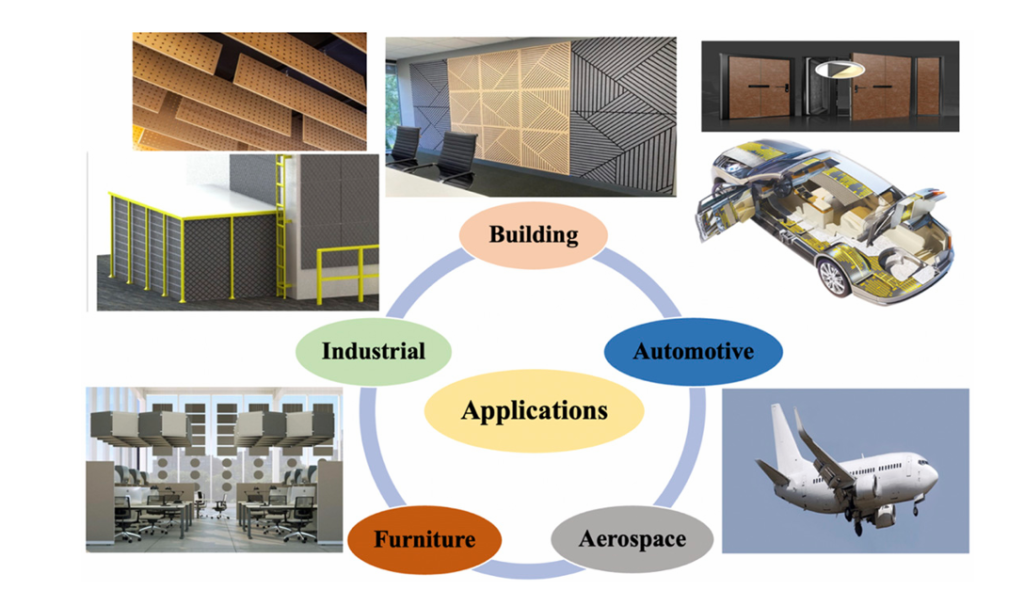
1. Automotive & Transportation
- Interior Noise Control: Acoustic textiles are widely used in car interiors—floor carpets, headliners, seat backs, and wheel well liners—to reduce cabin noise and vibration.
- Electric Vehicles (EVs): With the absence of engine noise, EVs demand advanced acoustic solutions. Lightweight nonwoven composites from recycled fibres are critical to dampen road and tyre noise without compromising vehicle range.
- Eco-Friendly Materials: PLA-based composites reinforced with natural fibres (kenaf, jute, hemp) are being tested as sustainable alternatives to petroleum-based foams. They provide both sound absorption and weight reduction, aligning with green mobility goals.
2. Building & Civil Engineering
- Indoor Acoustics: Acoustic textiles are used in offices, auditoriums, and classrooms to control reverberation time. Examples include nonwoven baffles, stretch-fabric wall systems, and acoustic wallpapers.
- Insulation Panels: Polypropylene and recycled textile batts serve as cavity wall insulation, offering dual benefits—thermal resistance (R-value) and acoustic performance (Sound Transmission Class, STC).
- Sustainable Construction: Boards made from garment waste and recycled cotton/polyester nonwovens are emerging as eco-friendly alternatives to fibreglass. Studies show that sponge-like structures derived from textile waste exhibit high absorption coefficients across mid-to-high frequencies.
3. Wearable Technology
- SonoTextiles & Smart Acoustic Fabrics: Moving beyond passive absorption, textiles are now integrated with sensors and triboelectric nanogenerators to actively interact with sound.
- Assistive Devices: Acoustic fabrics embedded in clothing can enhance speech perception for the hearing-impaired by filtering background noise.
- Biometric Monitoring: Smart acoustic textiles are being developed for athletes and patients, capable of monitoring respiration, heart rate, and even voice commands. This represents a paradigm shift from passive materials to active, responsive devices.
4. Other Emerging Applications
- Consumer Electronics: Acoustic fabrics are used in speaker enclosures, headphones, and microphones to improve sound clarity.
- Aerospace: Lightweight acoustic composites are applied in aircraft interiors to reduce cabin noise while meeting strict weight and fire safety standards.
- Furniture & Interior Design: Upholstery fabrics with engineered porosity are applied in chairs, partitions, and decorative panels to enhance acoustic comfort in homes and offices.
Conclusion:
Acoustic textiles have transitioned from conventional sound-absorbing felts to multifunctional, high-performance engineered systems that embody the principles of sustainability, circular economy, and intelligent design. What once served merely as passive insulation materials are now scientifically optimised structures carefully engineered at the fibre, pore, and composite levels—to control sound across targeted frequency ranges while simultaneously delivering thermal, mechanical, and environmental benefits.
The evolution is particularly striking in two dimensions. First, the shift toward natural fibres, recycled garment waste, and bio-based composites demonstrates how acoustic performance and environmental responsibility can coexist. Recycled denim boards, sponge-like textile waste panels, and PLA–natural fibre composites illustrate that waste streams can be transformed into value-added, technically competitive products. Second, the integration of sensing technologies, triboelectric nanogenerators, and AI-enabled systems signals a new era where textiles no longer merely absorb sound; they detect, interpret, and respond to it.
From automotive cabins and energy-efficient buildings to wearable health-monitoring garments, acoustic textiles now operate at the intersection of materials science, textile engineering, acoustics, and digital intelligence. Their role is expanding from passive noise control toward active, adaptive, and data-driven functionality.
Ultimately, the journey “from waste to wearables” reflects more than material innovation; it represents a paradigm shift in how we define textiles themselves. As research continues to refine microstructural design, enhance multifunctional performance, and embed intelligent systems within fibres and fabrics, acoustic textiles will increasingly shape quieter, healthier, and smarter living environments.
References:
[1] Shao, B., Wu, T.-C., Yan, Z.-X., Ko, T.-Y., Peng, W.-C., Jhan, D.-J., Chang, Y.-H., Fong, J.-W., Lu, M.-H., Yang, W.-C., Chen, J.-Y., Lu, M.-Y., Sun, B., Liu, H.-J., Liu, R., & Lai, Y.-C. (2025). Deep learning–empowered triboelectric acoustic textile for voice perception and intuitive generative AI-voice access on clothing. Science Advances, 11(41), eadx3348. https://doi.org/10.1126/sciadv.adx3348
[2] Prasetiyo, I., Nisa, A. K., Gunawan, G., Adhika, D. R., & Sihar, I. (2025). Influential properties on sound-absorption behavior of textile material-based multi-layer composite. Textile Research Journal, 95(3–4), 785–798. https://doi.org/10.1177/00405175241260434
[3] El Messiry, M., Eid, E. M., & Ayman, Y. (2025). Development of low-cost textile sound absorber boards from garment and textile waste using a sponge-like structure. Journal of Engineered Fibers and Fabrics, 20. https://doi.org/10.1177/15589250251354842
[4] Wang, Y., Sun, C., & Ahmed, D. (2025). A smart acoustic textile for health monitoring. Nature Electronics, 8, 485–495. https://doi.org/10.1038/s41928-025-01386-2
[5] Mohammadi, M., Ishak, M. R., Sultan, M. T. H., & Zainudin, E. S. (2025). Cutting-edge innovations in sound absorption properties of natural fiber reinforced polylactic acid composites. Journal of Reinforced Plastics and Composites. Advance online publication. https://doi.org/10.1177/07316844251352718
[6] Ghermezgoli, Z. M., Moezzi, M., Yekrang, J., Rafat, S. A., Soltani, P., & Barez, F. (2021). Sound absorption and thermal insulation characteristics of fabrics made of pure and crossbred sheep waste wool. Journal of Building Engineering, 35, 102060. https://doi.org/10.1016/j.jobe.2020.102060
[7] Kaspar, J., D’Amore, G. K. O., Ferrari, J., Armelloni, E., Ballerini, V., Valdiserri, P., di Schio, E. R., Pilotelli, M., Soltanian, H., & Neri, M. (2026). Multifunctional performance assessment of insulation panels from recycled textiles and Kenaf/Hemp Fibers: Thermal, acoustic, and fire behavior. Cleaner Materials, 19, 100373. https://doi.org/10.1016/j.clema.2026.100373
[8] Tao, Y., Ren, M., Zhang, H., Peijs, T., & Bilotti, E. (2021). Recent progress in acoustic materials and noise control strategies – A review. Applied Materials Today, 24, 101141. https://doi.org/10.1016/j.apmt.2021.101141
[9] Atinzar-Navarro, R., Bonet-Aracil, M., Gisbert-Payá, J., del Rey, R., & Picó, R. (2020). Sound absorption of textile fabrics doped with microcapsules. Applied Acoustics, 164, 107285. https://doi.org/10.1016/j.apacoust.2020.107285
[10] Sakthivel, S., Senthil Kumar, S., Melese, B., Mekonnen, S., Solomon, E., Edae, A., Abedom, F., & Gedilu, M. (2021). Development of nonwoven composites from recycled cotton/polyester apparel waste materials for sound absorbing and insulating properties. Applied Acoustics, 180, 108126. https://doi.org/10.1016/j.apacoust.2021.108126
[11] Karimi, F., Soltani, P., Zarrebini, M., & Hassanpour, A. (2022). Acoustic and thermal performance of polypropylene nonwoven fabrics for insulation in buildings. Journal of Building Engineering, 50, 104125. https://doi.org/10.1016/j.jobe.2022.104125
About the author: Dedicated PhD scholar at NIT Jalandhar with a recent Master's from NIFT New Delhi. Over a decade of expertise in the textile industry, spanning home furnishings, velvet, carpet, bedsheets, suiting, and shirting. Successful in roles like Shift In-Charge, Manufacturing Manager, and Training Manager. Successfully empowered Omani women in textiles through the Oman government (NTF) sponsored training program. Driven by a passion for the industry, committed to advancing sectoral excellence. Proficient in analytical thinking, innovation, and continuous improvement. Eager to acquire new knowledge, tackle challenges, and collaborate effectively in diverse teams. A valuable asset to organisations sharing the same vision and values.
Read More
- Introduction to Weaving and Shuttle Looms
- Handloom to High Street: Why Traditional Textiles Matter Today
- Lean Manufacturing Tools in the Textile & Apparel Industry
- CO₂ vs Water Dyeing: A Sustainable Comparison
- The Rise of Sustainable Textile Insulation Materials
- Innovations in Smart Textiles for Wearable Comfort
- Recent Advancements in Weaving Technology
- Wyzenbeek vs Martindale: Fabric Test Comparison
- Differences Between SAM and SMV in Garment Manufacturing
- Exploring the Future: Smart Textiles and Their Influence on Technological Innovation
- China’s Cotton Topping Robot: Revolutionizing Xinjiang’s Fields at 10x Speed
- Smart Garments for Elderly Health Monitoring and Active Living
- Call for Submissions: Share Your Expertise in Textile and Apparel
- Redesigning the Breath of Life: A Next-Gen N95 That Filters More Than Air