Introduction
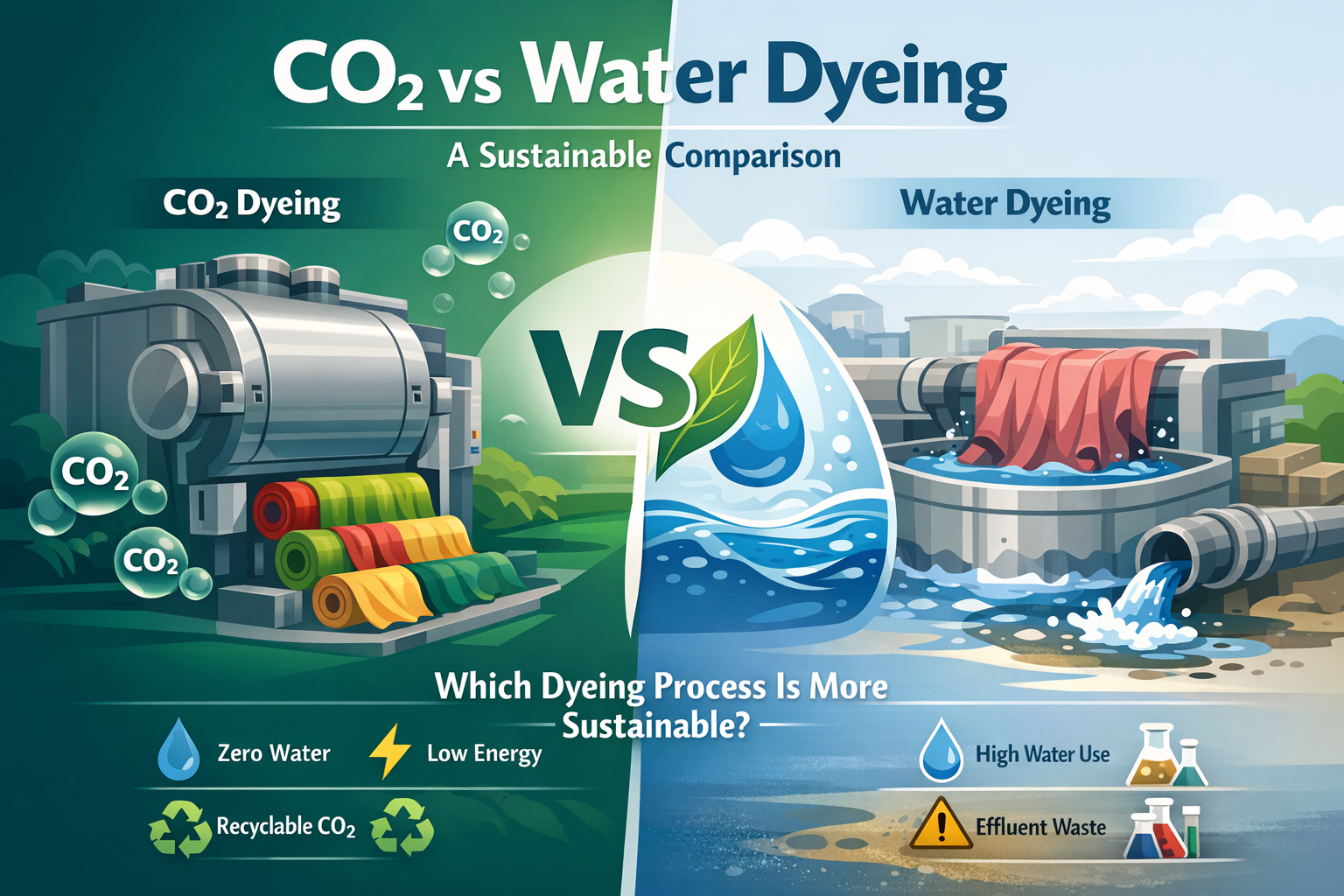
Textile dyeing is the process of introducing colour into fibres, yarns, or fabrics using dyes, auxiliaries, water or other media, and controlled conditions of time, temperature, and mechanical action. Conventional dyeing relies on water as the primary medium, whereas emerging technologies, such as supercritical CO₂, utilise compressed carbon dioxide as a solvent to carry dyes into fibres.
Sustainable dyeing methods are important because the textile sector is a major consumer of fresh water and energy and a significant generator of colored and chemically complex effluents. Untreated or poorly treated dyehouse wastewater can damage aquatic ecosystems and pose long-term risks to human health, driving interest in low-impact alternatives such as CO₂ dyeing and other low-emission technologies.
Basics of Water Dyeing
How aqueous dyeing works
In water-based dyeing, dyes and auxiliaries are dissolved or dispersed in water, and fabrics or yarns are immersed or padded with the liquor, followed by controlled heating and holding to allow diffusion and fixation of the dye in the fiber. Typical process steps include pre-treatment (desizing, scouring, bleaching), dyeing (exhaust, pad–batch, pad–steam, continuous), and multiple rinsing and soaping stages to remove unfixed dye and auxiliaries.
Dye–fiber interaction mechanisms vary: reactive dyes form covalent bonds with cellulosic fibers, disperse dyes are physically dissolved in synthetic fibers such as polyester, and direct dyes attach mainly through hydrogen bonding and van der Waals forces to cellulosics. Choice of dye class, pH, electrolyte, and temperature determines color yield and fastness properties in conventional aqueous dyeing.
Machinery, conditions, and chemicals
Common aqueous dyeing machines include winch dyeing machines, jet dyeing machines, overflow dyeing machines, beam dyeing machines, jiggers for wovens, and continuous ranges with padding mangles and steamers. These machines usually operate at atmospheric pressure up to the boil for many cellulosic processes, and at elevated temperature and pressure (around 130 °C) in pressurized jets or beams for polyester dyeing with disperse dyes.
Chemicals used include electrolytes (e.g., sodium chloride, sodium sulfate), alkali for reactive dyes, dispersing agents, surfactants, pH buffers, sequestering agents, leveling agents, and reduction/oxidation systems depending on the dye class. After dyeing, large volumes of hot water are required for rinsing, soaping, and neutralization, contributing significantly to the total water and energy footprint of a dyehouse.
Advantages and common applications
- High versatility across fiber types (cotton, viscose, wool, silk, polyester, nylon, acrylic blends).
- Mature, robust technology with wide equipment availability and extensive know-how from lab to bulk production in all major textile hubs.
- Suitable for most dye classes and color shades, from pale pastels to deep dark shades, with established recipes and quality-control protocols.
Aqueous dyeing is standard for cotton knits and wovens, home textiles, denim, synthetics, and blends across batch and continuous processes. It remains the reference technology against which new systems like supercritical CO₂ are compared in terms of performance and cost.
Limitations of water-based dyeing
- Very high water consumption for liquor preparation, dyeing, rinsing, and washing, often amounting to tens of liters per kilogram of fabric.
- Effluent rich in color, high chemical oxygen demand (COD), salts, surfactants, and auxiliary chemicals, which is difficult and costly to treat.
- Significant energy requirement to heat large volumes of water and then to dry the fabric, which increases the overall carbon footprint.
- Possible color fastness issues when fixation is incomplete, leading to higher rinse loads, re-dyeing, and increased resource usage.
Understanding CO₂ Dyeing (Supercritical CO₂)
What supercritical CO₂ is
A supercritical fluid is a state of matter obtained when a substance is above its critical temperature and critical pressure, where it shows properties intermediate between a gas and a liquid. Supercritical CO₂ (SC-CO₂) is typically generated at pressures around 7.4 MPa and above and temperatures above about 31 °C, and industrial dyeing often uses somewhat higher pressure and temperature to enhance solubility and mass transfer.
In this state, CO₂ has gas-like diffusivity and low viscosity combined with liquid-like density and solvent power, allowing it to penetrate porous materials and dissolve suitable dyes. SC-CO₂ is non-flammable, relatively non-toxic, and widely used in other industries such as coffee decaffeination and extraction of natural products, providing a technological base for textile applications.
Concept and process flow of CO₂ dyeing
In SC-CO₂ dyeing, carbon dioxide is compressed and heated to its supercritical state and used as the dye medium instead of water. Dyes compatible with SC-CO₂ (mainly disperse dyes) are introduced into the pressurized system, where they dissolve in the supercritical fluid and are transported into the hydrophobic fiber matrix.
A simplified process flow is:
- Loading: Fabric or yarn package is loaded into a high-pressure dyeing vessel.
- Pressurization and heating: CO₂ is pumped into the vessel and brought to supercritical conditions with controlled temperature and pressure.
- Dye injection and circulation: Dyes are introduced, and SC-CO₂ is circulated through the textile material to ensure uniform contact and penetration.
- Depressurization and recovery: After the dyeing time, the system is depressurized, causing CO₂ to revert to gas; most CO₂ is captured, condensed, and recycled for the next batch.
- Unloading: Dyed fabric is removed, typically already essentially dry because no liquid water is used.
Machinery and closed-loop systems
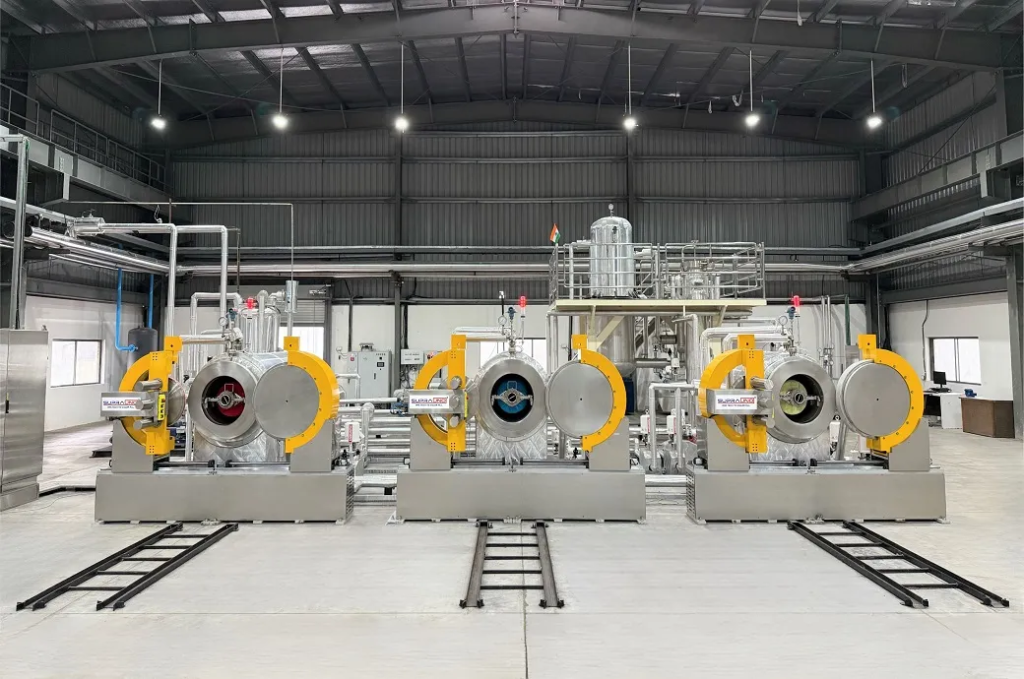
Supercritical CO₂ dyeing machines are pressure-rated vessels with high-pressure pumps, heat exchangers, CO₂ storage, dye metering units, filtration systems, and control systems. The design focuses on closed-loop circulation to recover and reuse CO₂, minimizing losses and avoiding emissions to the workplace environment.
Commercial systems, such as those introduced by DyeCoo and more recently other suppliers, integrate CO₂ recovery, dye filtration, and automated recipe control, allowing industrial-scale batch dyeing of synthetic fabrics. Newer installations also integrate energy recovery and advanced safety systems to improve overall economics and reliability.
Benefits of CO₂ dyeing
Key advantages include:
- Zero process water use for the dyeing step, dramatically reducing total water demand and eliminating colored dyeing effluent from that stage.
- No separate drying step, because fabric exits the vessel essentially dry, which can cut total energy use and process time compared to water-based dyeing plus drying.
- Closed-loop solvent recovery: Most of the CO₂ is captured, recompressed, and reused, with only small make-up quantities required, improving resource efficiency.
- Improved dye penetration and potentially higher color yield for suitable fibers such as polyester, due to the high diffusivity and solvent power of SC-CO₂.
- Reduced auxiliary chemicals, since there is no need for salts or surfactants as in many aqueous systems, which simplifies downstream treatment and reduces chemical load.
- Shorter processing times in many reported cases, because dyeing and “drying” effectively occur in a single integrated step.
Challenges and limitations
Despite its benefits, SC-CO₂ dyeing has important limitations:
- High capital cost for pressure-rated equipment, compressors, and safety systems, which can be a barrier for small and medium-sized dyehouses.
- Current technology is most suitable for hydrophobic fibers such as polyester and, to some extent, nylon; hydrophilic natural fibers (cotton, wool) are more challenging due to lower dye solubility and fiber–dye interactions in SC-CO₂.
- Limited compatibility with some dye classes; most work focuses on disperse dyes, and developing suitable dye formulations for a wider range of colors and fibers remains an active research area.
- Need for specialized technical skills for operation, maintenance, and safety in high-pressure systems, which may not be readily available in all textile clusters.
- Economic competitiveness can depend strongly on local energy prices, CO₂ sourcing, production scale, and regulatory pressures on water use and effluent discharge.
Side-by-Side Comparison (CO₂ vs Water Dyeing)
Key technical and sustainability aspects
Practical implications
For many commodity cotton products in regions with abundant water and lenient regulations, water dyeing remains economically dominant. In water-stressed or highly regulated regions, or for large polyester programs where consistent quality and environmental performance are priorities, SC-CO₂ systems can be more attractive despite higher capital costs.
Environmental and Sustainability Benefits
Reduced effluents
Traditional dyehouses discharge large volumes of wastewater containing residual dyes, salts, surfactants, and other auxiliaries, which can cause coloration, toxicity, and oxygen depletion in receiving waters. Even with treatment, managing these effluents is challenging and costly, and incomplete removal of color and chemicals is common.
Supercritical CO₂ dyeing effectively eliminates colored wastewater from the dyeing step because no water is used as a solvent and dye residues are contained within the closed system. This drastically lowers the load on effluent treatment plants and can simplify overall environmental management in integrated mills.
Lower carbon footprint: pros and cons
On the positive side, SC-CO₂ dyeing can reduce total energy use by removing or shrinking the drying stage and decreasing hot-water usage, which in many mills is a key contributor to greenhouse gas emissions. Reduced chemical consumption and lower wastewater treatment requirements can further cut indirect emissions related to chemical production and effluent management.
However, CO₂ must be compressed to high pressure, which consumes electricity; if this electricity comes from carbon-intensive sources, the climate advantage may be reduced or, in extreme cases, offset. Comprehensive life-cycle assessments show that the climate benefit of SC-CO₂ dyeing is strongest when coupled with efficient equipment and low-carbon energy mixes.
Recyclability of CO₂
A major sustainability feature of SC-CO₂ dyeing is that the same CO₂ is recirculated multiple times through a closed loop. After dyeing, CO₂ is depressurized, condensed, and stored for reuse, so only a relatively small amount of fresh CO₂ is required, often sourced as a by-product from other industries rather than produced specifically for dyeing.
This recirculation means that CO₂ is functioning as a working fluid rather than being consumed, aligning with circular resource-use principles. Along with reduced water and chemical use, this contributes to SC-CO₂ dyeing’s classification as a promising green technology for the textile sector.
Current Industry Trends
Commercial implementations and brands
Several major sportswear and fashion brands have adopted waterless CO₂ dyeing technologies for selected polyester product lines, often promoting them as “waterless dyeing” or “DryDye” type concepts. DyeCoo’s technology, for example, has been used commercially by companies such as Nike and Adidas to dye polyester fabrics and garments with reduced environmental impact.
In India, Arvind Limited, in collaboration with H&M Group and Deven Supercriticals, has recently commissioned a supercritical CO₂ dyeing unit reported as the country’s first commercial installation of this kind. This unit, marketed under the Suprauno brand, claims significant savings in water, energy, and chemicals at scale, indicating growing interest in large textile-producing regions.
Technological advancements and future scope
Ongoing research continues to expand SC-CO₂ dyeing from pure polyester to blended fabrics such as polyester/cotton, using modified process conditions and auxiliaries to improve dye uptake on the hydrophilic component. Researchers are also exploring optimized dye chemistries, co-solvents, and process integration with other supercritical treatments to broaden the fiber and color space.
Future developments may focus on:
- Lower-cost equipment designs and modular systems to improve accessibility for mid-sized mills.
- Integration with renewable-energy-based steam or electricity to enhance net climate benefits.
- Coupling SC-CO₂ dyeing with recycling-oriented processes, such as dye extraction from waste textiles using supercritical fluids, to support circular textile systems.
Conclusion
Conventional water-based dyeing remains the most versatile and widely used method for cellulosic fibers, blends, and many product categories, especially where water is relatively accessible and regulations are less stringent. Supercritical CO₂ dyeing is particularly advantageous for hydrophobic fibers like polyester produced at large scale in regions facing water scarcity, strict environmental regulations, or strong brand pressure for low-impact products.
Both methods will likely coexist, with aqueous dyeing continually optimized for better resource efficiency and SC-CO₂ technology expanding as equipment costs fall and compatible dye/fiber systems grow. Sustained innovation in cleaner dyeing technologies—supported by regulations, brand commitments, and academic–industrial collaboration—is essential to reduce the environmental burden of color in textiles while maintaining performance and cost-effectiveness.
References
- Zhao, H., Wang, Y., Zhao, Q., & Xiong, X. (2025). A supercritical carbon dioxide dyeing strategy for polyester/cotton blended fabrics with excellent dyeing performance. The Journal of Supercritical Fluids, 226, 106726. https://doi.org/10.1016/j.supflu.2025.106726
- Schmidt-Przewozna, K., & Rój, E. (2023). Green sustainable textile supercritical dyeing process using CO₂ madder (Rubia tinctorum L.) extract. Journal of Natural Fibers, 20(2), 2277836. https://doi.org/10.1080/15440478.2023.2277836
- Broadbent, P. J., Carr, C. M., Lewis, D. M., Rigout, M. L., Siewers, E. J., & Shojai Kaveh, N. (2023). Supercritical carbon dioxide (SC–CO₂) dyeing of cellulose acetate: An opportunity for a “greener” circular textile economy. Coloration Technology, 139(4), 475–488. https://doi.org/10.1111/cote.12690
- Elsisi, H., Elmaaty, T.A., Negm, E. et al. Dyeing wool fabrics with specialized dyes and their mixtures using supercritical CO2. Sci Rep 15, 40377 (2025). https://doi.org/10.1038/s41598-025-25134-w
- Berradi, M., Hsissou, R., Khudhair, M., Assouag, M., Cherkaoui, O., El Bachiri, A., & El Harfi, A. (2019). Textile finishing dyes and their impact on aquatic environs. Heliyon, 5, e02711. https://doi.org/10.1016/j.heliyon.2019.e02711
- Agrawal, B. J. (2015). Supercritical carbon-dioxide assisted dyeing of textiles: An environmental benign waterless dyeing process. International Journal of Innovative Research in Computer and Communication Engineering, 3(2), 201-206. https://www.ijirct.org/papers/IJIRCT1201043.pdf
- Sayam, S., Das, N., Akter, S., Saha, J., Sarker, A., Sen, A., Habibullah, H., Sajib, G. A., Haque, I., Mia, M. B., Faruk, M. O., Fatema, S., Munshi, M. K., Paul, P. C., & Haider, M. I. (2025). Water and electricity consumption patterns with effluent quality in the textile processing industry of Bangladesh. RSC Advances, 15(66), 46627-46648. https://doi.org/10.1039/D5RA05917H
- Kant, R. (2012). Textile dyeing industry an environmental hazard. Natural Science, 4(1), 22-26. https://doi.org/10.4236/ns.2012.41004
- Waterless carbon dioxide dyeing is a powerful solution for sustainable colouration. (2023). Texspace Today.
- Arvind Limited Unveils India’s First Supercritical CO₂ Dyeing Machine, Revolutionizing Sustainable Textile Manufacturing
Read More
- The Rise of Sustainable Textile Insulation Materials
- Innovations in Smart Textiles for Wearable Comfort
- Recent Advancements in Weaving Technology
- Wyzenbeek vs Martindale: Fabric Test Comparison
- Differences Between SAM and SMV in Garment Manufacturing
- Exploring the Future: Smart Textiles and Their Influence on Technological Innovation
- China’s Cotton Topping Robot: Revolutionizing Xinjiang’s Fields at 10x Speed
- Smart Garments for Elderly Health Monitoring and Active Living
- Call for Submissions: Share Your Expertise in Textile and Apparel
- Redesigning the Breath of Life: A Next-Gen N95 That Filters More Than Air
- History and Development of Suture
Significantly better approach for sustainable dyeing industries with no harm to our mother nature.
Thank You
Your thoughts are always so well-organized and presented.
Thank You
I do not even know how I ended up here, but I thought this post was good. I do not know who you are but definitely you are going to a famous blogger if you aren’t already 😉 Cheers!
Thank You