Introduction
As the world intensifies its focus on sustainability and energy efficiency, a quiet revolution is brewing in the world of insulation. For decades, we’ve relied on petroleum-based synthetics and energy-intensive materials to keep our homes warm, our clothing cozy, and our industries safe. However, these conventional options come with a significant environmental cost, contributing substantially to pollution and resource depletion.
A fresh wave of innovation is permeating the textile sector. Researchers and engineers are utilising natural resources and waste materials to create high-performance, sustainable thermal insulation products that are equally effective, if not superior to conventional options. Let us examine the materials and technology that are defining a more sustainable and environmentally friendly future.
Why the Shift to Sustainable Insulation?
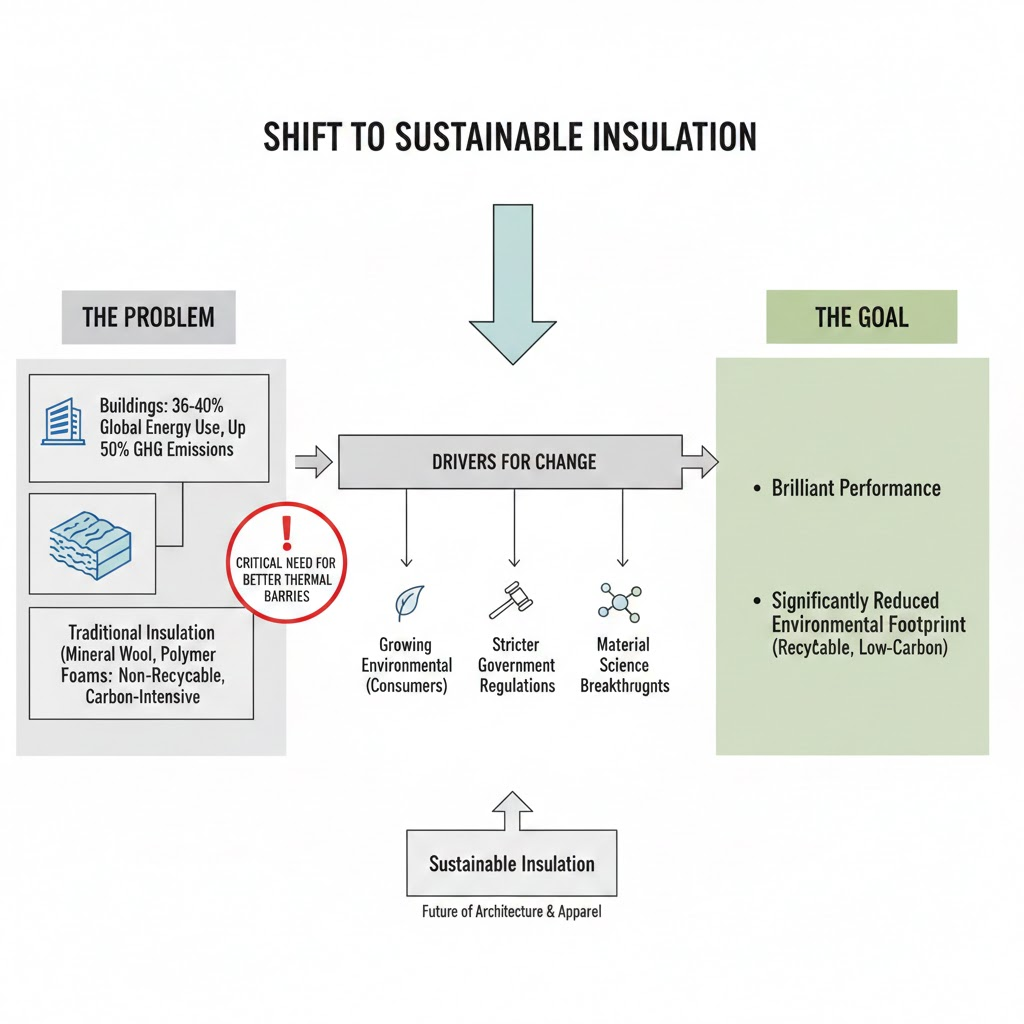
Buildings alone are responsible for a staggering 36-40% of global energy use and up to 50% of greenhouse gas emissions. This highlights a critical need for better thermal barriers in both architecture and apparel. The traditional kings of insulation materials, like mineral wool and polymer foams, are not inherently sustainable. They often lack recyclability and are produced using carbon-intensive processes.
The drive for change comes from three key areas: growing environmental awareness among consumers, stricter government regulations, and breakthroughs in material science. The goal is clear: create insulation that performs brilliantly while significantly reducing its environmental footprint.
How Does Textile Insulation Work?
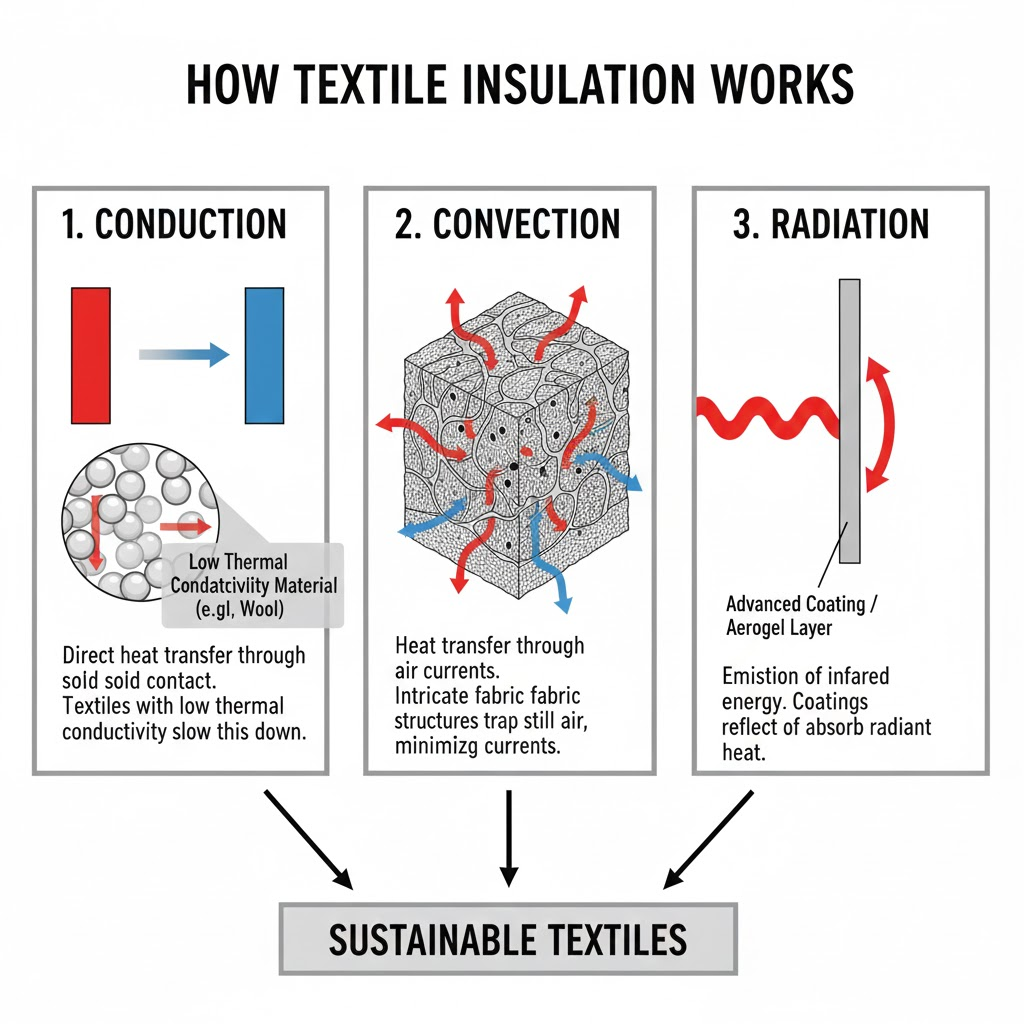
To appreciate these new materials, it helps to understand the basics of heat transfer. There are three ways heat escapes:
- Conduction: The direct transfer of heat through solid contact. Materials with low thermal conductivity, such as wool, are excellent at slowing this process down.
- Convection: The movement of heat through air currents within a material’s pores. Fabrics with intricate structures trap still air, a natural insulator, to minimise this.
- Radiation: The emission of infrared energy. Advanced coatings and aerogels can reflect or absorb this radiant heat, keeping it where it’s needed.
Sustainable textiles are engineered to masterfully disrupt all three of these heat transfer pathways.
The New Generation of Sustainable Insulating Materials
A diverse range of eco-friendly options is now available, each with unique benefits.
1. Natural & Regenerated Fibres: Back to Basics
- Wool: Nature’s superstar insulator. Its inherent crimped structure creates millions of tiny air pockets, providing excellent thermal resistance. Wool also manages moisture brilliantly, retaining its insulating properties even when damp, and is naturally flame-resistant.
- Hemp & Flax: These plant-based fibres are emerging as powerful building insulation materials. With thermal conductivity values as low as 0.029 W/m·K (for flax composites), they rival traditional fibreglass. They are highly porous, effectively trapping air, and are biodegradable.
- Bamboo & Lyocell: Sourced from fast-growing bamboo and wood pulp, these regenerated cellulosic fibres offer superb thermal qualities. Lyocell, in particular, is produced in a closed-loop system that recycles water and solvents, making its manufacturing process as sustainable as the end product.
2. Recycled Polymer-Based Materials: Turning Trash into Warmth
- Recycled Polyester (rPET): Made from post-consumer plastic bottles and textile waste, rPET is a cornerstone of the circular economy. It uses 50-70% less energy to produce than virgin polyester and performs consistently, even when wet. Nonwovens blending rPET with recycled denim have shown excellent thermal resistance (R-value of 2 K/W).
- Post-Consumer Textile Composites: Companies are now transforming old clothing into building insulation panels. These nonwoven mats, often made from recycled cotton/polyester blends, achieve thermal conductivity values around 0.039 W/m·K, diverting waste from landfills and creating a useful new product.
3. High-Tech Aerogel-Embedded Textiles: The Ultimate Insulator
Aerogels are the lightest solids known to humanity, consisting of over 99% air. When integrated into textiles, they offer unparalleled performance.
- Silica Aerogels: With a phenomenal thermal conductivity as low as 0.013 W/m·K, aerogels are in a league of their own. A mere 30 g/m² of aerogel-embedded pearls can provide the same warmth as 120 g of conventional filler, making garments 75% lighter.
- 3D Spacer Fabrics with Aerogel: By embedding aerogel into three-dimensional woven structures, researchers have created composites that block 46.5% of heat. This technology is ideal for extreme cold-weather apparel and aerospace applications where weight and packability are critical.
4. Bio-Based Composites: The Future is Plant-Powered
These materials combine natural fibres with biopolymers derived from renewable resources.
- Polylactic Acid (PLA) Composites: PLA, made from corn or sugar beet, is reinforced with fibres like flax or hemp to create rigid insulation panels. These composites are fully biodegradable under the right conditions, offering a true “cradle-to-cradle” solution.
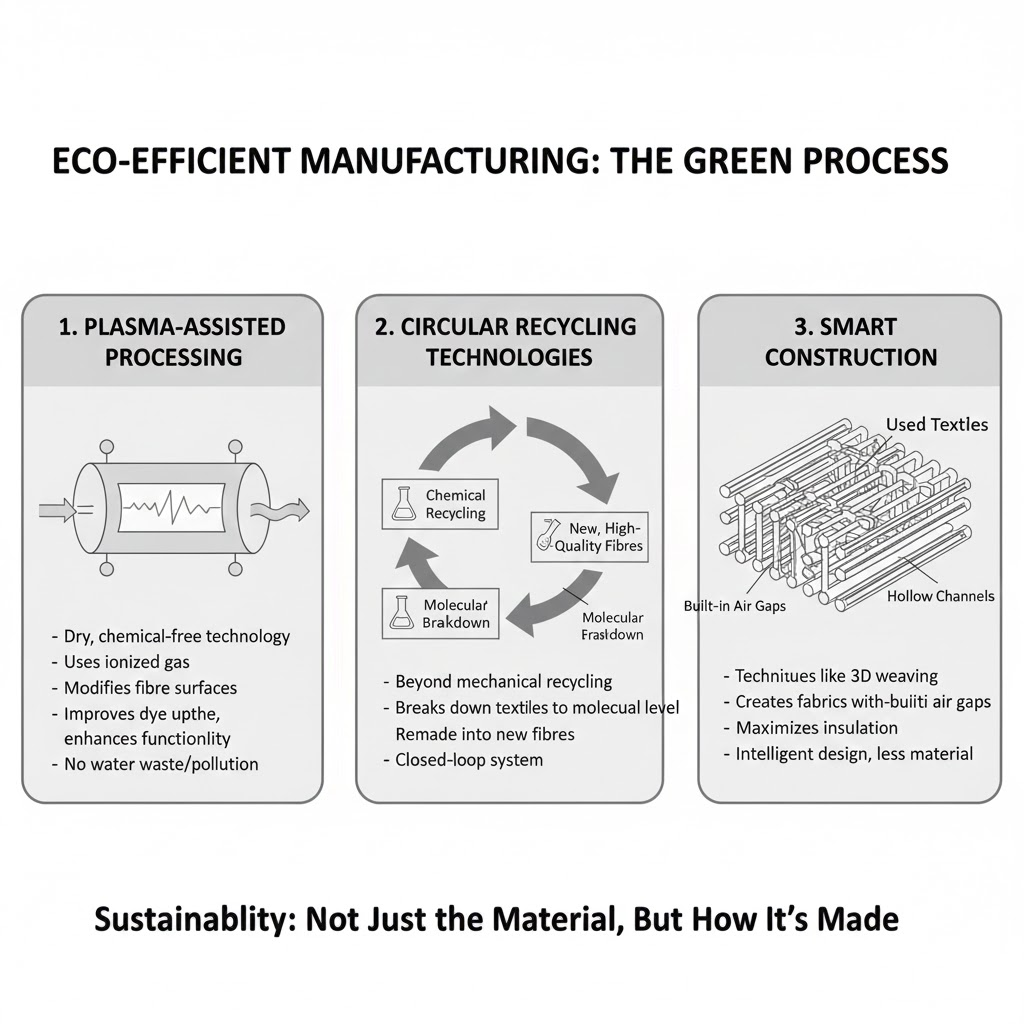
Eco-Efficient Manufacturing: The Green Process
Sustainability isn’t just about the material itself; it’s also about how it’s made. Revolutionary manufacturing processes are reducing the environmental impact of textile production:
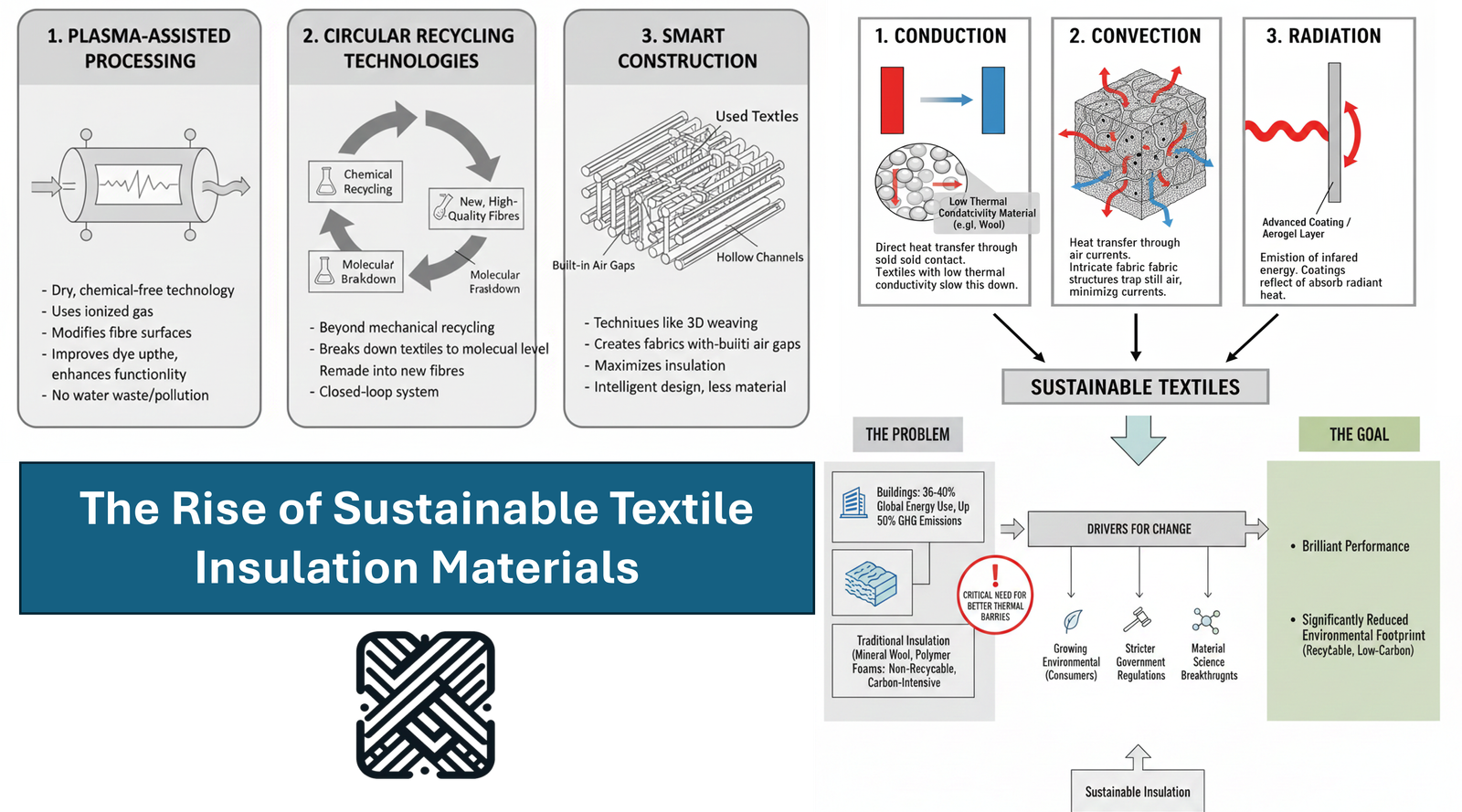
- Plasma-Assisted Processing: This dry, chemical-free technology uses ionized gas to modify fibre surfaces, improving dye uptake and enhancing functionality without water waste or pollution.
- Circular Recycling Technologies: Beyond mechanical recycling, advanced chemical recycling can break down textiles to the molecular level, allowing them to be remade into new, high-quality fibres in a closed-loop system.
- Smart Construction: Techniques like 3D weaving create fabrics with built-in air gaps and hollow channels, maximising insulation through intelligent design rather than adding more material.
Real-World Applications: From Mountaineering to Modern Homes
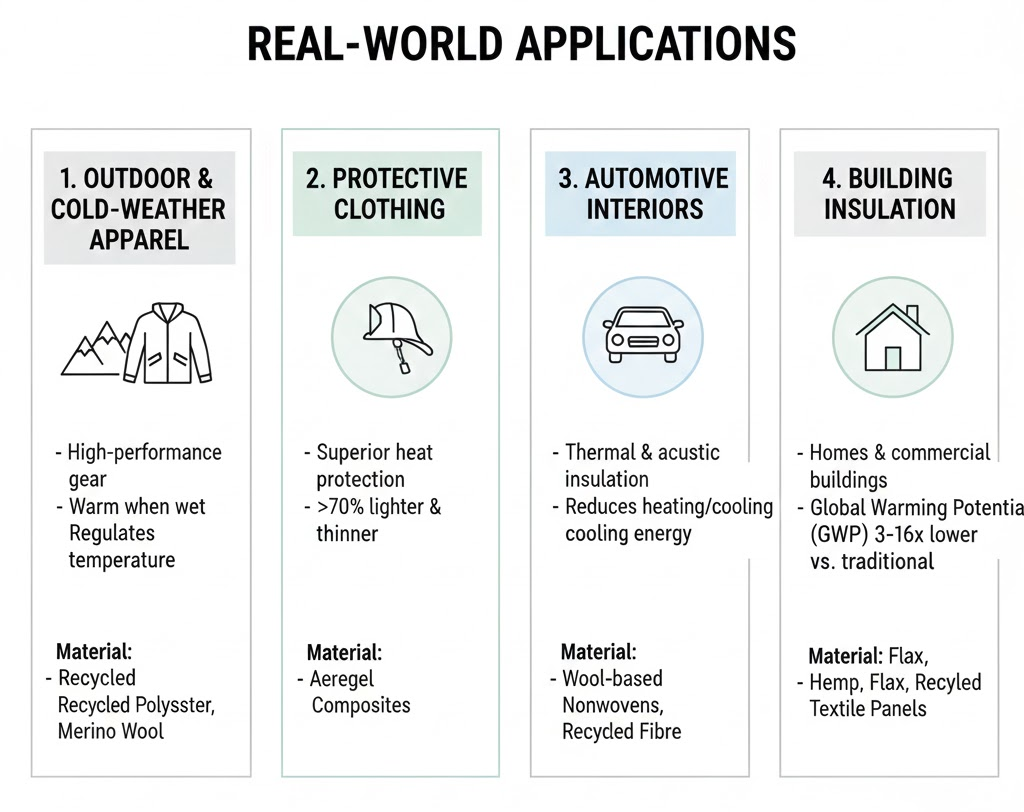
These sustainable materials are already making a difference across industries:
- Outdoor & Cold-Weather Apparel: Brands are using recycled polyester insulation and merino wool to create high-performance gear that stays warm when wet and regulates temperature during intense activity.
- Protective Clothing: Firefighting gear is being reimagined with aerogel composites, offering superior heat protection while being over 70% lighter and thinner than traditional gear.
- Automotive Interiors: Wool-based nonwovens and recycled fibre composites are providing effective thermal and acoustic insulation for car cabins, reducing the energy needed for heating and cooling.
- Building Insulation: Hemp, flax, and recycled textile panels are being used to insulate homes and commercial buildings. Lifecycle assessments indicate that these materials have a global warming potential 3 to 16 times lower than traditional stone wool.
Conclusion
The journey toward sustainable thermal insulation is a powerful example of how innovation can align performance with planetary responsibility. By harnessing natural fibres, giving new life to waste, and leveraging cutting-edge science, such as aerogels, we no longer have to choose between staying warm and protecting the environment.
These advanced textile solutions demonstrate that it is entirely possible to create high-performance insulation for our clothing, vehicles, and buildings that meets our needs without costing the Earth. As these technologies continue to evolve and scale, they promise a future where our pursuit of comfort and efficiency is accompanied by a deep and abiding respect for our planet.
References
- Samardzioska, T., Jovanoska, M., & Grujoska, V. (2023). Sustainable thermal insulation derived from recycled textile waste. Advances in Environmental and Engineering Research, 4(1), 1–19. https://doi.org/10.21926/aeer.2301004
- Ferreira, D. P., Cruz, J., & Fangueiro, R. (2020). Recent advances in green composites based on PLA and bast fibres. In Green composites: Processing, characterisation and applications for textiles (pp. 1–29). Polymers, 12, 2373.
- Kandhavadivu, P., Rathinamoorthy, R., & Surjit, R. (2014). Thermoregulatory characteristics of bamboo / lyocell union fabrics. Indian Journal of Fibre & Textile Research, 39, 386–393.
- Siddique, A., Baitab, D. M., Khan, M. I., Asghar, M. A., Afzal, A., & Umair, M. (2025). 3D woven interlocking patterns with enhanced mechanical and thermophysical characteristics. Journal of Engineered Fibers and Fabrics, 20, 1–11. https://doi.org/10.1177/15589250251342852
- Sahoo, P. K., Datta, R., Rahman, M. M., & Sarkar, D. (2024). Sustainable environmental technologies: Recent development, opportunities, and key challenges. Applied Sciences, 14(23), 10956. https://doi.org/10.3390/app142310956
- Trivedi, A. K., Gupta, M. K., & Singh, H. (2023). PLA based biocomposites for sustainable products: A review. Advanced Industrial and Engineering Polymer Research, 6, 382–395. https://doi.org/10.1016/j.aiepr.2023.02.002
- Koken, A., & Kanik, M. (2023). Investigation of thermal and solar properties of aerogel powder coated textiles. Materials Science (Medžiagotyra), 29(3), 382–388. https://doi.org/10.5755/j02.ms.32869
- Koken, A., & Kanik, M. (2023). Thermal and solar properties of aerogel powder coated textiles. Materials Science, 29(3), 382–388.
- Haji, A., & Naebe, M. (2020). Cleaner dyeing of textiles using plasma treatment and natural dyes: A review. Journal of Cleaner Production, 257, 120975. https://doi.org/10.1016/j.jclepro.2020.120975
- John, M. J. (2022). Biobased alginate treatments on flax fibre reinforced PLA and PHBV composites. Current Research in Green and Sustainable Chemistry, 5, 100319. https://doi.org/10.1016/j.crgsc.2022.100319
- Okokpujie, I. P., Essien, V., Ikumapayi, O. M., Nnochiri, E. S., Okokpujie, K., & Akinlabi, E. T. (2022). An overview of thermal insulation material for sustainable engineering building application. International Journal of Design & Nature and Ecodynamics, 17(6), 831–841. https://doi.org/10.18280/ijdne.170603
- Sanivada, U. K., Mármol, G., Brito, F. P., & Fangueiro, R. (2020). PLA composites reinforced with flax and jute fibers—A review of recent trends, processing parameters and mechanical properties. Polymers, 12(10), 2373. https://doi.org/10.3390/polym12102373
- Bhatia, A. (2015). Overview of insulation materials. Course No: T05-004. Continuing Education and Development, Inc.
Read More
- Innovations in Smart Textiles for Wearable Comfort
- Recent Advancements in Weaving Technology
- Wyzenbeek vs Martindale: Fabric Test Comparison
- Differences Between SAM and SMV in Garment Manufacturing
- Exploring the Future: Smart Textiles and Their Influence on Technological Innovation
- China’s Cotton Topping Robot: Revolutionizing Xinjiang’s Fields at 10x Speed
- Smart Garments for Elderly Health Monitoring and Active Living
- Call for Submissions: Share Your Expertise in Textile and Apparel
- Redesigning the Breath of Life: A Next-Gen N95 That Filters More Than Air
- History and Development of Suture
- Different Blending methods with their advantages and disadvantages
- The methods of measuring the thermal insulation and water vapor permeability of fabrics
- Six Sigma: A Comprehensive Guide to Process Excellence
- Transforming Textiles with Nanotechnology: Applications and Advances
- The Science and Innovation Behind Waterproof Breathable Fabrics
- Classification of Protective Textiles
Very Informative article
Thank You
It’s interesting to see the shift away from petroleum-based insulation; I was just researching similar trends and found some helpful information on https://seed3d.ai. Hopefully, these sustainable alternatives become more widely adopted soon.
Whats Happening i am new to this, I stumbled upon this I’ve found It positively helpful and it has aided me out loads. I am hoping to give a contribution & aid other users like its aided me. Great job.