
Introduction:
The textile and apparel industry operates in one of the most complex manufacturing environments globally. High product variety, short fashion cycles, labour-intensive processes, strict quality requirements, and increasing pressure for cost efficiency and sustainability make operational excellence a constant challenge.
Manufacturers are expected to deliver high-quality products at competitive costs, while simultaneously reducing lead time, minimising waste, and complying with environmental and social standards. Traditional production systems, which rely heavily on excess inventory, reactive problem solving, and manual coordination, are no longer sufficient to meet these demands.
In this context, lean manufacturing has emerged as a powerful and proven approach for improving productivity, stabilising operations, and creating value across the textile and apparel supply chain. Lean manufacturing is not merely a set of tools; it is a comprehensive approach to manufacturing. It is a systematic philosophy of waste elimination, process optimisation, and continuous improvement. When applied correctly, lean principles can transform spinning mills, weaving units, wet processing plants, and garment factories into efficient, predictable, and customer-focused production systems.
This article presents a comprehensive overview of lean manufacturing tools specifically applied to the textile and apparel industry, with a focus on engineering principles, industrial engineering (IE) practices, and shop-floor implementation.
Understanding Lean Manufacturing from an Engineering Perspective
Lean manufacturing is a structured methodology aimed at maximising customer value while minimising resource consumption. It focuses on identifying and eliminating activities that do not add value from the customer’s perspective.
From an industrial engineering perspective, lean addresses three critical dimensions of manufacturing performance:
- Flow efficiency – reducing waiting time and interruptions
- Process stability – minimising variation in output and quality
- Resource optimisation – effective use of labour (Man), machines, and materials
In textile and apparel manufacturing, waste commonly appears in the form of:
- Excess raw material, WIP, and finished goods inventory
- Operator waiting and idle machine time
- Rework due to sewing, cutting, or finishing defects
- Frequent machine breakdowns and setup losses
- Unbalanced production lines and bottleneck operations
- Excessive material handling and operator motion
Lean manufacturing enables factories to produce exactly what is required, at the required pace, with minimal waste, while maintaining consistent quality.
Why Lean Manufacturing Is Essential in Textile and Apparel Production
The textile and apparel industry is characterised by:
- High product and style variability
- Short product life cycles and frequent changeovers
- Labour-intensive manual operations
- Tight delivery schedules and cost targets
- Increasing demand for sustainability and compliance
These conditions make production systems highly vulnerable to inefficiencies and variability.
Lean manufacturing helps organisations to:
- Improve productivity without increasing manpower
- Reduce cost per unit through waste elimination
- Improve quality and reduce defect rates
- Shorten order-to-delivery lead time
- Increase production visibility and control
- Build a culture of continuous improvement
For engineers and IE teams, lean provides quantitative tools and structured methods to analyse, design, and improve production systems.
Core Lean Manufacturing Tools for the Textile & Apparel Industry
The following lean tools are particularly effective when applied across spinning, weaving, processing, and garment manufacturing operations.
1. 5S – Workplace Organisation and Motion Waste Reduction
Definition
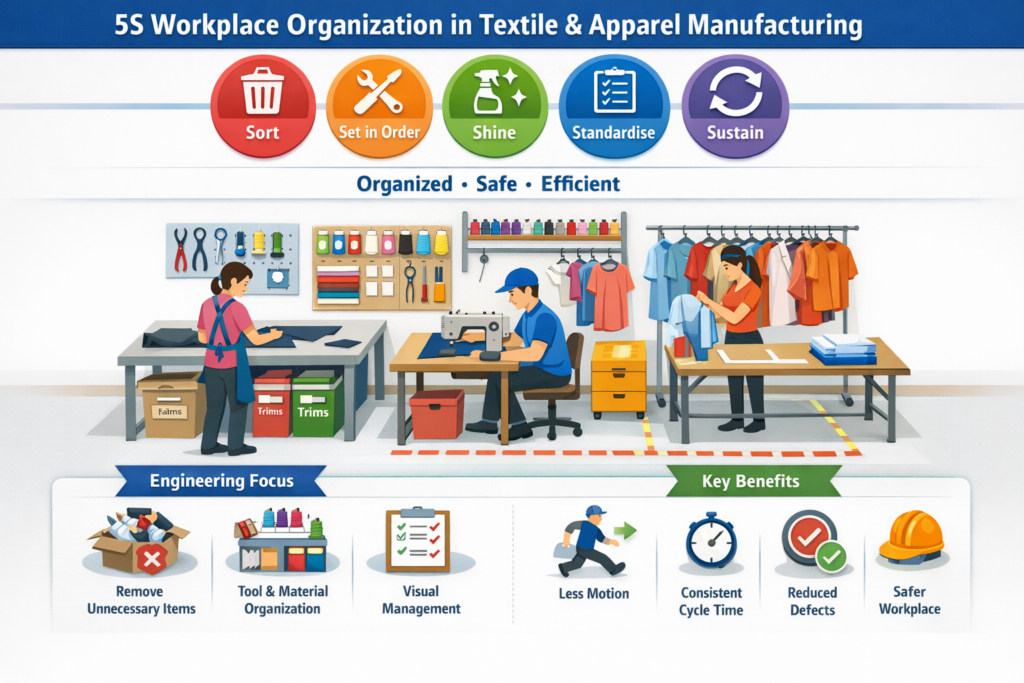
5S is a workplace organisation methodology consisting of Sort, Set in Order, Shine, Standardise, and Sustain. Its objective is to create an organised, safe, and efficient working environment.
Application in Textile and Apparel Manufacturing
Unorganised workstations in cutting rooms, sewing lines, and finishing areas lead to excessive operator movement, time loss, and quality errors.
Engineering Focus
- Elimination of unnecessary tools and materials
- Standardised placement of tools, trims, and accessories
- Visual identification of storage locations and material flow paths
Benefits
- Reduced operator motion and fatigue
- Improved cycle time consistency
- Lower defect rates
- Enhanced workplace safety
2. Kaizen – Continuous Improvement Culture
Definition
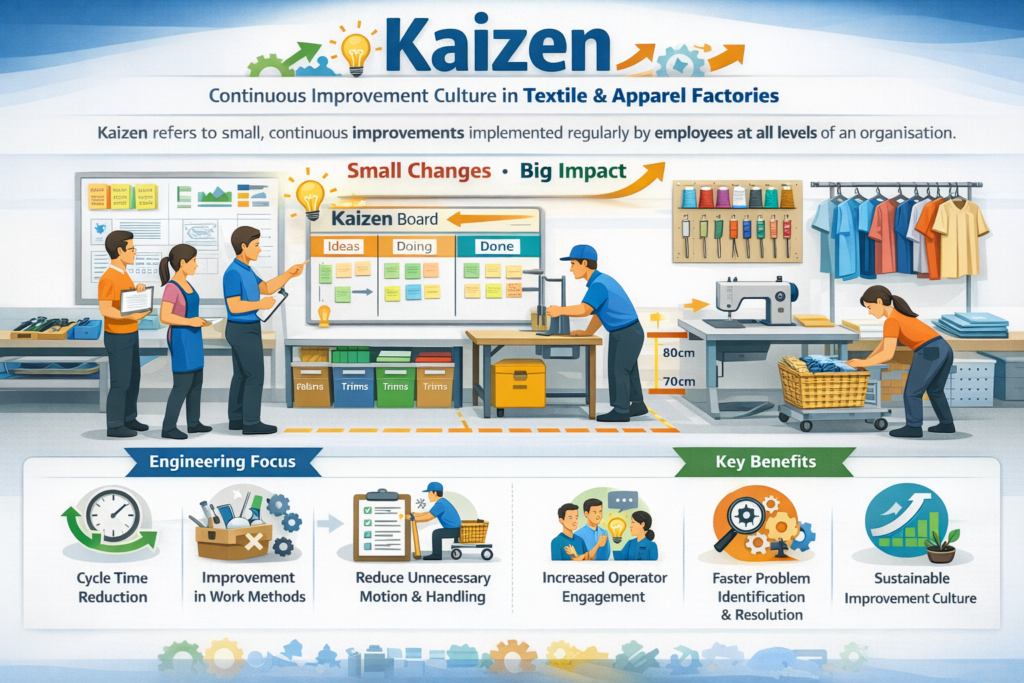
Kaizen refers to small, continuous improvements implemented regularly by employees at all levels of an organisation.
Application
Instead of relying on large capital investments, kaizen focuses on low-cost process improvements such as layout changes, method optimisation, and ergonomic adjustments.
Engineering Focus
- Cycle time reduction
- Improvement in work methods
- Reduction of unnecessary motion and handling
Benefits
- Increased operator engagement
- Faster problem identification and resolution
- Sustainable improvement culture
3. Value Stream Mapping (VSM) – Lead Time and Flow Analysis
Definition
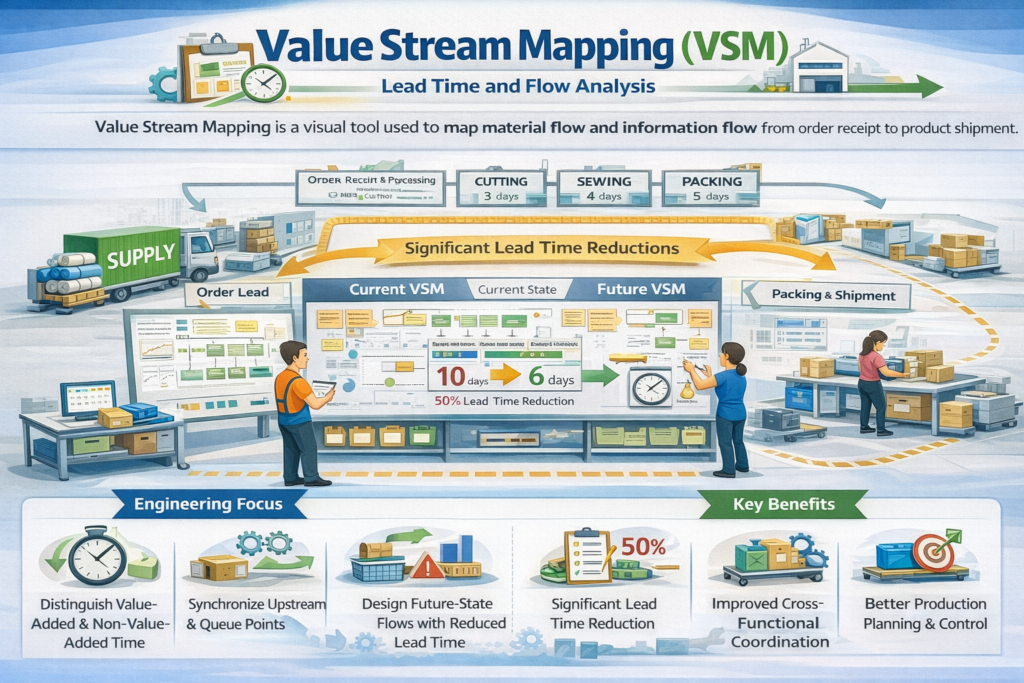
Value Stream Mapping is a visual tool used to map material flow and information flow from order receipt to product shipment.
Application
VSM is particularly effective in identifying waiting time, excessive inventory, and process disconnections between departments.
Engineering Focus
- Distinguishing value-added and non-value-added time
- Identifying bottlenecks and queue points
- Designing future-state flows with reduced lead time
Benefits
- Significant reduction in total lead time
- Improved cross-functional coordination
- Better production planning and control
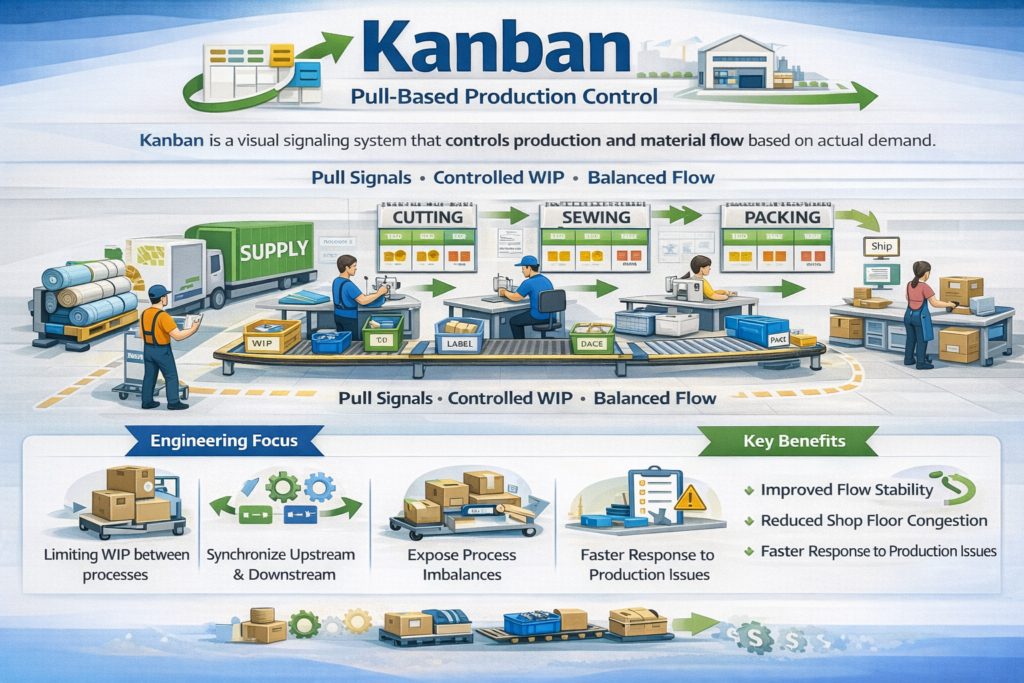
4. Kanban – Pull-Based Production Control
Definition
Kanban is a visual signalling system that controls production and material flow based on actual demand.
Application
In many apparel factories, push-based systems result in overproduction and excessive WIP accumulation.
Engineering Focus
- Limiting WIP between processes
- Synchronizing upstream and downstream operations
- Exposing process imbalances
Benefits
- Improved flow stability
- Reduced congestion on the shop floor
- Faster response to production issues
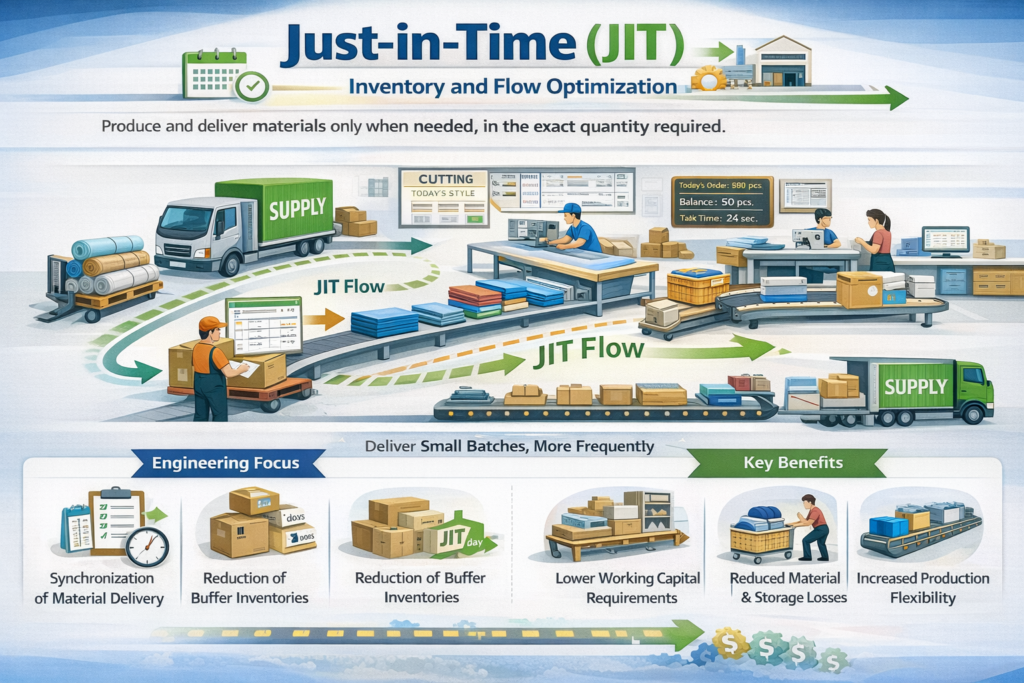
5. Just-in-Time (JIT) – Inventory and Flow Optimization
Definition
Just-in-Time aims to produce and deliver materials only when needed, in the exact quantity required.
Application
Excess fabric, trims, and accessories increase storage costs, risk damage, and hide production inefficiencies.
Engineering Focus
- Synchronization of material delivery with production schedules
- Reduction of buffer inventories
- Improved supplier coordination
Benefits
- Lower working capital requirements
- Reduced material handling and storage losses
- Increased production flexibility
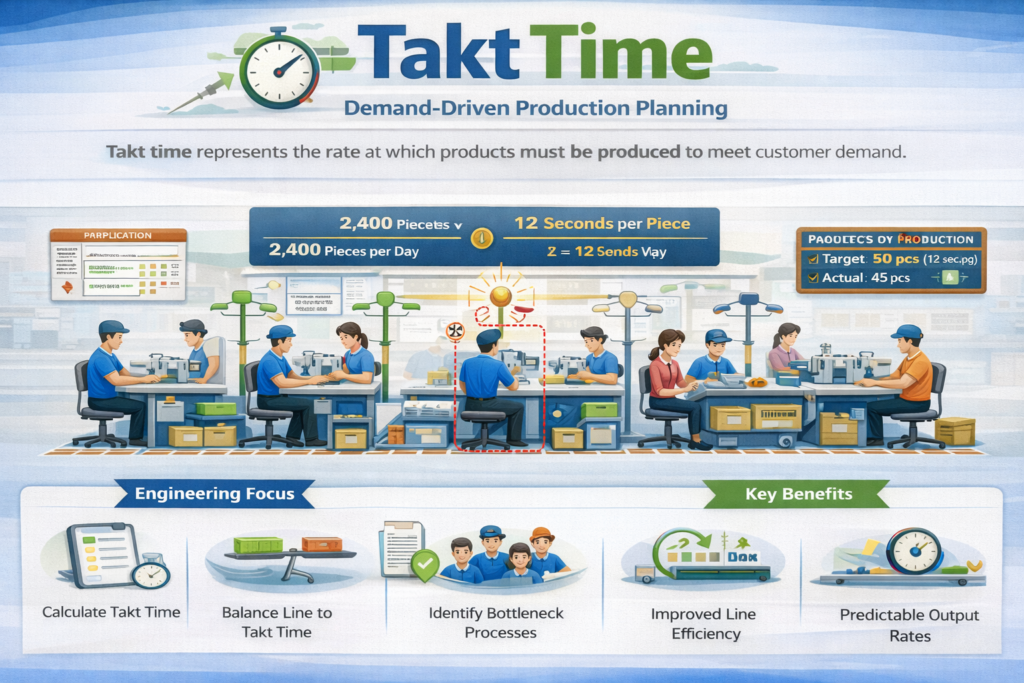
6. Takt Time – Demand-Driven Production Planning
Definition
Takt time represents the rate at which products must be produced to meet customer demand.
Application
Unbalanced sewing lines often result in operator overload, idle time, and bottlenecks.
Engineering Focus
- Calculation of takt time based on available production time and demand
- Line balancing to match operation cycle times with takt time
- Identification of bottleneck processes
Benefits
- Balanced workload across operators
- Improved line efficiency
- Predictable output rates
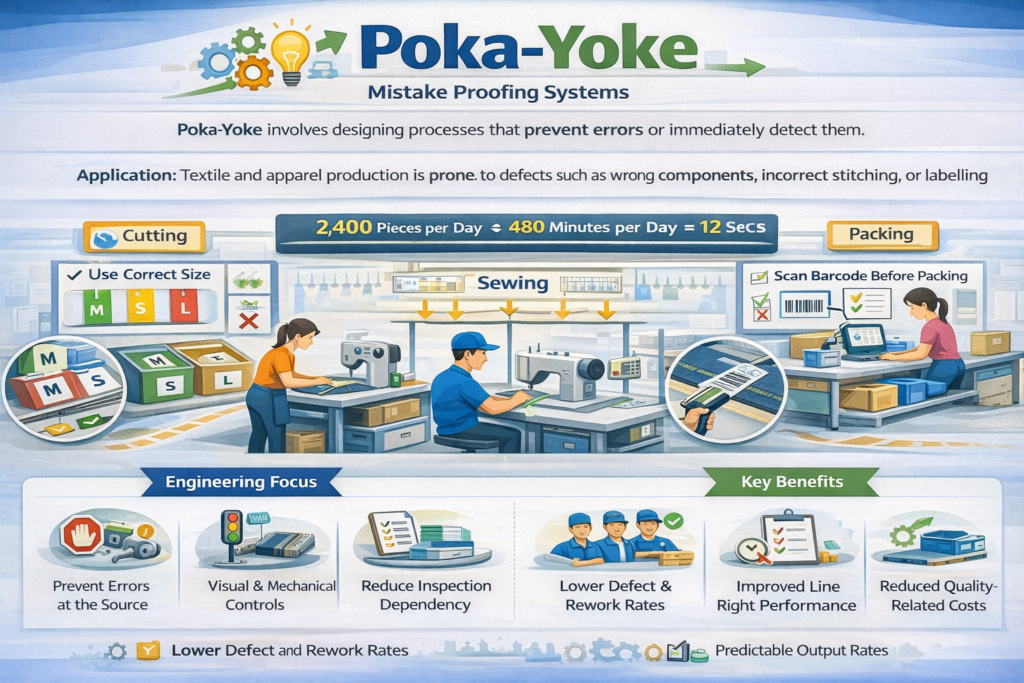
7. Poka-Yoke – Mistake Proofing Systems
Definition
Poka-yoke involves designing processes that prevent errors or immediately detect them.
Application
Textile and apparel production is prone to defects such as wrong components, incorrect stitching, or labelling errors.
Engineering Focus
- Error prevention at the source
- Use of visual and mechanical controls
- Reduction of inspection dependency
Benefits
- Lower defect and rework rates
- Improved first-time-right performance
- Reduced quality-related costs
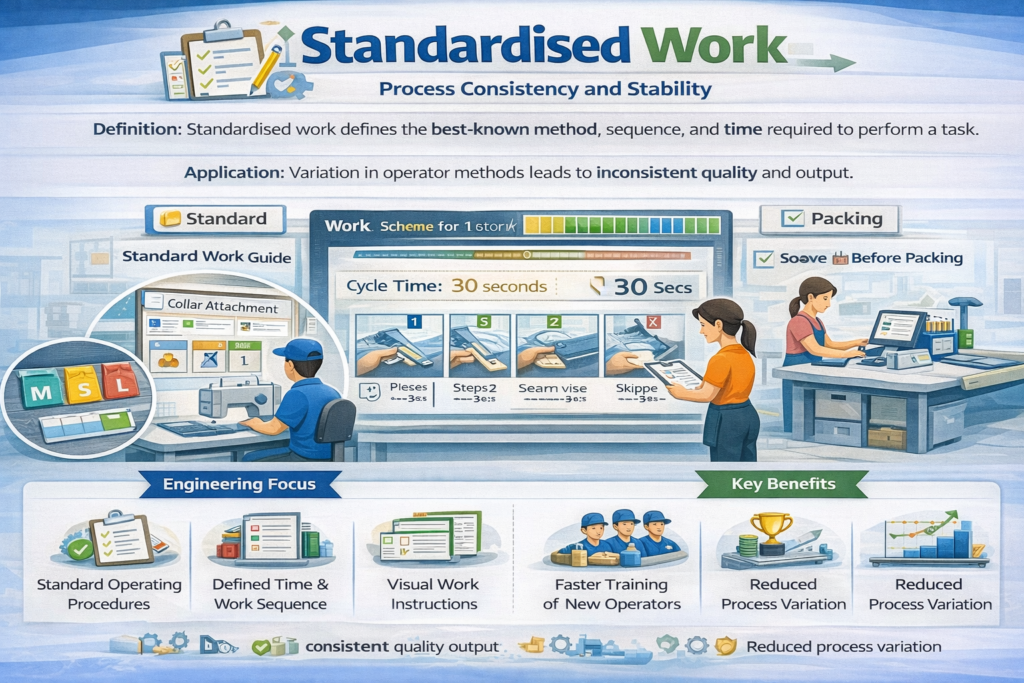
8. Standardised Work – Process Consistency and Stability
Definition
Standardised work defines the best-known method, sequence, and time required to perform a task.
Application
Variation in operator methods leads to inconsistent quality and output.
Engineering Focus
- Documentation of standard operating procedures
- Defined work sequence and cycle time
- Visual work instructions at the workstation
Benefits
- Consistent quality output
- Faster training of new operators
- Reduced process variation
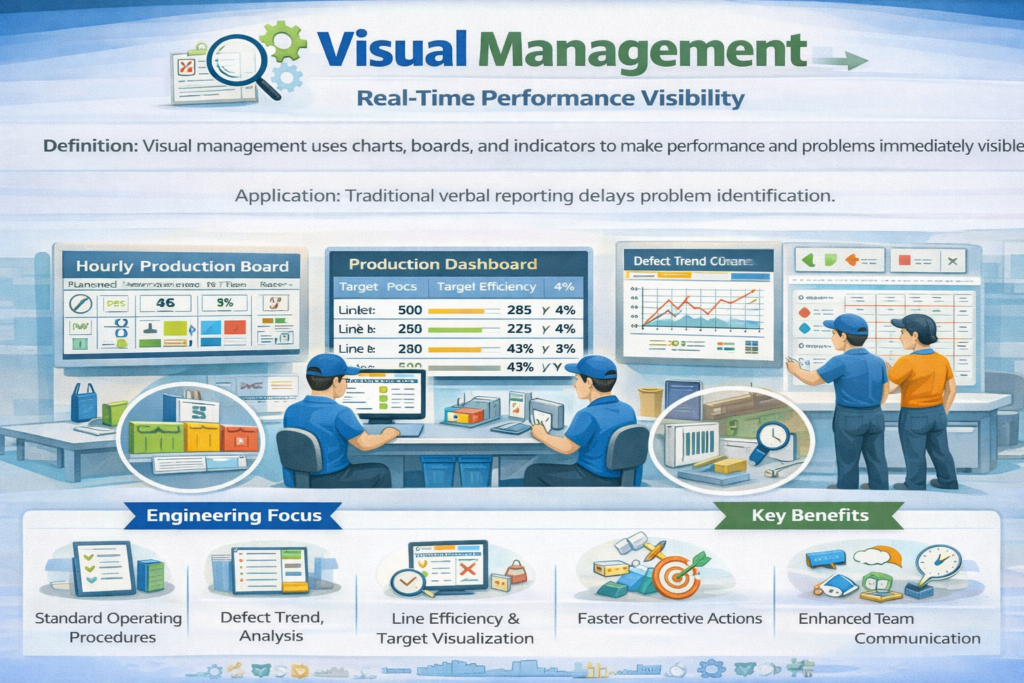
9. Visual Management – Real-Time Performance Visibility
Definition
Visual management uses charts, boards, and indicators to make performance and problems immediately visible.
Application
Traditional verbal reporting delays problem identification.
Engineering Focus
- Hourly production tracking
- Defect trend analysis
- Line efficiency and target visualization
Benefits
- Faster corrective actions
- Improved accountability
- Enhanced team communication
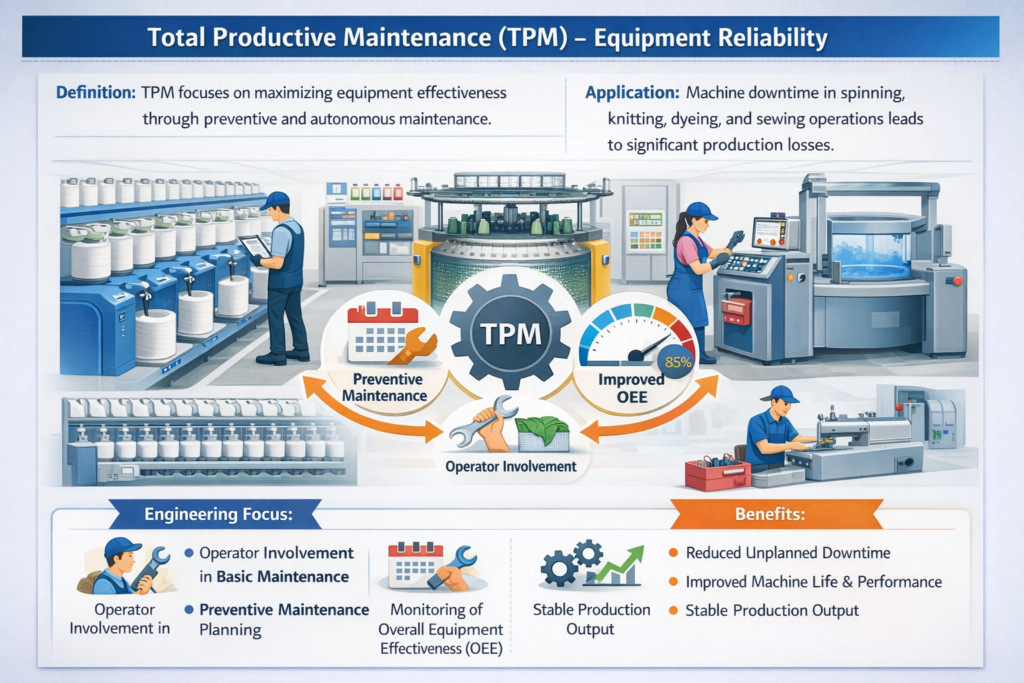
10. Total Productive Maintenance (TPM) – Equipment Reliability
Definition
TPM focuses on maximising equipment effectiveness through preventive and autonomous maintenance.
Application
Machine downtime in spinning, knitting, dyeing, and sewing operations leads to significant production losses.
Engineering Focus
- Operator involvement in basic maintenance
- Preventive maintenance planning
- Monitoring of Overall Equipment Effectiveness (OEE)
Benefits
- Reduced unplanned downtime
- Improved machine life and performance
- Stable production output
Overall Benefits of Lean Manufacturing in the Textile & Apparel Industry
When implemented systematically, lean manufacturing delivers:
- Higher labour and machine productivity
- Lower production cost per unit
- Reduced WIP and lead time
- Improved quality and customer satisfaction
- Enhanced workplace safety and compliance
- Reduced material waste and energy consumption
Lean practices also support sustainability objectives by minimising rework, overproduction, and resource consumption.
Common Challenges in Lean Implementation
Despite its benefits, lean implementation often faces obstacles:
- Resistance to Change: Employees may perceive lean as additional workload rather than process improvement. Start with small improvements and demonstrate visible benefits.
- Lack of Lean Knowledge: Incorrect application of lean tools can result in poor outcomes. Focus on practical, shop-floor-based training for engineers and supervisors.
- Weak Management Commitment: Lean initiatives fail when treated as short-term projects. Regular leadership involvement through reviews and shop-floor visits.
- Poor Data Discipline: Inaccurate production data undermines lean analysis. Strengthen basic data collection and reporting systems.
Conclusion
The textile and apparel industry is evolving toward digitisation, automation, and smart manufacturing systems. Lean manufacturing provides the foundational discipline required to successfully adopt Industry 4.0 technologies. Without stable processes, accurate data, and standardised work, digital tools cannot deliver their full potential.
Lean manufacturing is therefore not a one-time improvement project, but a long-term operational mindset. Organizations that embed lean principles into their daily operations will be better equipped to respond to market changes, improve profitability, and sustain competitive advantage.
References
- Villena-Cruzado, E. L., Rodríguez-Camayo, K. K., & Tupia-De-La-Cruz, E. L. (2025). Lean‑TPM integration for quality and efficiency improvement in Peruvian textile SMEs: A study on defect reduction and equipment effectiveness. SSRG International Journal of Industrial Engineering, 12(1), 1–11. https://doi.org/10.14445/23499362/IJIE-V12I1P101
- Caballero-Morales, S.-O., Cuautle-Gutiérrez, L., Cordero-Guridi, J.-d.-J., & Alvarez-Tamayo, R.-I. (2023). Six‑Sigma reference model for Industry 4.0 implementations in textile SMEs. Sustainability, 15(16), 12589. https://doi.org/10.3390/su151612589
- Alcazar-Zamora, P. A., Escalante-Cier, A. E., & Collao-Diaz, M. F. (2023, December 4–6). Production model based on lean manufacturing and TPM to increase efficiency in a company in the textile sector. In Proceedings of the 3rd LACCEI International Multiconference on Entrepreneurship, Innovation and Regional Development (LEIRD 2023). LACCEI. https://dx.doi.org/10.18687/LEIRD2023.1.1.589
- Rafael-Abad, A., Ancalle-Polanco, A., Quiroz-Flores, J. C., Collao-Diaz, M., & Flores-Pérez, A. (2023). Production model implementing lean manufacturing tools to increase order fulfillment in SMEs of the textile manufacturing sector. Journal of Economics, Business and Management, 11(3), 141–145. https://doi.org/10.18178/joebm.2023.11.3.751
- Rafael-Abad, A., Ancalle-Polanco, A., Quiroz-Flores, J. C., Collao-Diaz, M., & Flores-Pérez, A. (2023). Production model to increase the level of order fulfillment through the implementation of lean tools and ergonomics in SMEs of the textile sector. International Journal of Innovation, Management and Technology, 14(3), 88–92. https://doi.org/10.18178/ijimt.2023.14.3.943
- Alejandro-Torres, B. J., Yarma-Rivera, J. L., & Calderón-Gonzales, W. D. (2025). Lean‑TPM strategies for defect reduction and productivity gains: Evidence from a garment SME case study. ESP International Journal of Science, Humanities and Management Studies, 3(2), 1–14.
- Zhu, X., Zhang, B., & Yuan, H. (2022). Digital economy, industrial structure upgrading and green total factor productivity: Evidence in textile and apparel industry from China. PLOS ONE, 17(11), e0277259. https://doi.org/10.1371/journal.pone.0277259
- León-Ludena, L. A., Diestra-Medroa, C., & Flores-Perez, A. (2023, January 9–11). Improvement proposal to reduce the total cycle time in production through the application of SLP, 5S and TPM under a DMAIC approach in a Peruvian textile SME. In ICIEA-EU 2023: 2023 The 10th International Conference on Industrial Engineering and Applications (pp. 1–7). ACM. https://doi.org/10.1145/3587889.3587971
- Dominguez Julca, J. A., Algendones Amasifuen, E. A., & Chavez-Ugaz, R. (2024). Improvement proposal to increase the level of service by applying lean manufacturing tools in SMEs in the textile sector in Peru. In 2024 Congreso Internacional de Innovación y Tendencias en Ingeniería (CONIITI). IEEE. https://doi.org/10.1109/CONIITI64189.2024.10854859
- Calderón-Ayala, Y., Vitor-Sanchez, J., Quiroz-Flores, J. C., & Flores-Perez, A. (2023, July 17–21). Increased operational efficiency in an SME in the textile industry through a production model based on lean, TPM, and SLP tools. In Proceedings of the 21st LACCEI International Multi-Conference for Engineering, Education, and Technology. LACCEI. https://dx.doi.org/10.18687/LACCEI2023.1.1.186
- Kaka, A., Belhadi, A., Kamble, S. S., & Garza-Reyes, J. A. (2024). Lean waste prioritisation and reduction in the apparel industry: Application of waste assessment model and value stream mapping. Cogent Engineering, 11(1), 2341538. https://doi.org/10.1080/23311916.2024.2341538
- Rocha, T. A., & dos Santos, F. A. (2024). Underused lean manufacturing tools in the textile industry. e-TECH: Tecnologias para Competitividade Industrial, 17(2), 1–15.
Read More
- CO₂ vs Water Dyeing: A Sustainable Comparison
- The Rise of Sustainable Textile Insulation Materials
- Innovations in Smart Textiles for Wearable Comfort
- Recent Advancements in Weaving Technology
- Wyzenbeek vs Martindale: Fabric Test Comparison
- Differences Between SAM and SMV in Garment Manufacturing
- Exploring the Future: Smart Textiles and Their Influence on Technological Innovation
- China’s Cotton Topping Robot: Revolutionizing Xinjiang’s Fields at 10x Speed
- Smart Garments for Elderly Health Monitoring and Active Living
- Call for Submissions: Share Your Expertise in Textile and Apparel
- Redesigning the Breath of Life: A Next-Gen N95 That Filters More Than Air
- History and Development of Suture
Very well prepared ! Easily understood.
Thank You
Very well prepared ! Easily understood.
Thank You
Thông qua hệ thống tường lửa WAF 5 lớp và công nghệ mã xác thực 2AF, 888slot ẩn danh tuyệt đối mọi tài khoản người chơi đồng thời, mã hóa toàn bộ hoạt động khi hội viên truy cập, sử dụng dịch vụ, sản phẩm. Vì thế, bạn hoàn toàn có thể yên tâm khi cá cược tại đây. TONY01-12
I really appreciate content like this—it’s clear, informative, and actually helpful. Definitely worth reading!
Thank You
Thank you for making this topic less intimidating.
Thank You
Great points, well supported by facts and logic.
Thank You
Your content always adds value to my day.
Thank You
Your advice is exactly what I needed right now.
Thank You
Thank you for offering such practical guidance.
Thank You
Thank you for sharing this! I really enjoyed reading your perspective.
Thank You
Experience thrilling wins and endless entertainment at 777 bet Casino, your ultimate destination for online gaming.
This responsive and professional support team contributes significantly to the overall positive user experience on 777bet.
Сегодня цифровое развитие детей и подростков становится всё более и более востребованным.
—- https://grace-calipso.ru/
CANADAPHARMACY1 Viagra Cheapest Canada. Approved Canadian Pharmacy Store. viagra without prescription
:: CIALIS online :: Check these offers for Cialis from trusted
online pharmacy no prescription needed
Lowest Prices
Canada VIAGRA, LEVITRA, CIALIS Online. Lowest Prices!
purchase tamoxifen citrate online
Acyclovir Dosage Forms
canada drugs
mexican pharmacy no prescription needed
Canadian pharmacy online without prescription
canadian pharmacy no prescription
Cialis Generic
PHARMACY RX ONE VIAGRA cialis 40 mg Get really CHEAP VIAGRA – Compare the prices from trusted pharmacies canadian pharmacy no prescription Online drugstore Buy Viagra. Online CANADIAN Pharmacy. Mac Specialists in Western Canada for Business. healthy man viagra scam Cheap CIALIS Generic – LOWEST PRICES! BUY VIAGRA ONLINE – Order Viagra:Due to using of Viagra each man
Discover the excitement and win big with exclusive bonuses at fairspin promo code.
The trust in game outcomes grows with this approach, which significantly elevates player enjoyment and trust.
Whether you are looking for expert interior and exterior painting across the LA area, skilled painters deliver premium quality with zero mess completing the project on time tailored to your specific needs.
Link below; http://campusprogram.com/programs/statesubject/Kentucky/Urban_and_Planning_Studies.html
Для быстрого и эффективного избавления от неприятных соседей воспользуйтесь услугами профессиональное уничтожение клопов, чтобы вернуть дому комфорт и спокойствие.
Существует множество способов уничтожения клопов, среди которых бытовая химия занимает важное место.
Discover the thrill of the aviator game at aviator game, where precision and luck collide in the sky.
Learning through observation, players can detect patterns in how often cash-outs occur and plan accordingly.
pin-up çıxarış sənədləri pinup09715.help
pin-up rəsmi apk haradan http://pinup09715.help
В том случае если вы организуете поездку в Берлин, стоит обратить внимание на объекты, такие как берлинская стена и замки Берлина — допустим, берлинский дворец и другие замки в environs Берлина, которые отлично подойдут для дневных экскурсий. Для тех, кто интересуется историей, поездка в Потсдам из Берлина — это превосходный вариант, и между прочим, добраться туда можно исключительно удобно: берлин-потсдам как добраться — в деталях расписано тут как добраться из аэропорта берлина до автовокзала берлина .
Более того, для приезжих из Польши и Украины актуальна информация о протяженности и способах транспортировки: в том числе, познань-берлин расстояние, лодзь-берлин поезд или днепр-берлин поезд, а также ужгород-берлин поезд. Если arriving в аэропорт Берлин-Бранденбург, следует заранее разузнать, как добраться из аэропорта Берлина до автовокзала Берлина или других зон города — это даст возможность сэкономить много периода и сил на месте.
pin up pin-up http://www.pinup09715.help
Автосервис Тойота в Москве предлагает широкий спектр услуг. Профессионалы помогут вам с ремонтом и техническим обслуживанием.
Если вам нужен качественный и надежный автосервис Toyota в Москве, мы предлагаем широкий спектр услуг для вашего автомобиля.
Для Тойота необходим высокий уровень квалификации. Каждый механик проходит специальное обучение и сертификацию.
В нашем сервисе используются современные технологии и оборудование. Наличие современного оборудования существенно упрощает процесс диагностики.
Вы получите качественное и профессиональное обслуживание вашего автомобиля. Мы ценим каждого клиента и стремимся к его удовлетворенности.
Polska scena gier online ma do zaoferowania wiele rozrywek zwiazanych z vulkanspiele.
vulkanspiele code https://vulkan-spiele3.com/kod-promocyjny/
mostbet пополнение KGS карта mostbet пополнение KGS карта
mostbet служба поддержки http://www.mostbet85961.help
Автосервис Тойота в Москве предлагает широкий спектр услуг. В этом автосервисе вы найдете опытных техников, которые знают все о Тойота.
Если вам нужен качественный и надежный автосервис Тойота в Москве, мы предлагаем широкий спектр услуг для вашего автомобиля.
Для Тойота необходим высокий уровень квалификации. Каждый механик проходит специальное обучение и сертификацию.
В автосервисе установлено современное оборудование. Благодаря этому, мы можем гарантировать качество выполняемых работ.
Обращаясь в автосервис Тойота, вы можете рассчитывать на высокое качество услуг. Наши клиенты всегда остаются довольны результатом работ.
Gambling platforms in India continue to expand, showcasing dealer games with free spins and verified systems; before signing up check payment options — below are the platforms we recommend — https://adx24.com/profile/latanyacarlos .
https://www.cmyvcard.com/winnieduby956 .
В Краснодаре наш интернет магазин ковров предоставляет разнообразие товаров для оформления вашего дома.
Посмотреть ковры онлайн
Наши цены приятно удивят даже самых взыскательных покупателей.
Сегодня коммерческий видеоконтент становится ключевым инструментом любого маркетинга. Наша студия выполняет видео под ключ любой сложности в Москве. Если вам нужно узнать стоимость, смотрите примеры работ ниже.
Ссылка: https://studiya-videoprodakshn.ru/
Discover the excitement and top bonuses at ExBet, your ultimate destination for online gaming.
Regular tournaments and events keep the community engaged and provide ample opportunities to win.
TOP RATED GENERIC VIAGRA PHARMACY canadian pharmacy no prescription Buy Levitra Online tobuycialis.com Healthy man India Generic – Viagra, Cialis, Levitra on line pharmacy with no prescription • ACUNS/AUCEN: Association of Canadian online pharmacy RX MEX PHARMACY TOP1 PHARMACY USA canadian 24 hour pharmacy CANADIAN PHARMACIES TOP BEST Buy Viagra (Sildenafil) Online at EXTRA LOW PRICES!
мостбет Каспи вывод http://mostbet82043.help
Куршавель — это престижный горнолыжный курорт с невероятными пейзажами, который следует посетить, прежде всего если вам привлекательны французские Альпы. Для любителей истории и архитектуры Парижа необходимо увидеть такие места, как Нотр Дам де Пари, собор Парижской Богоматери, Сен Дени и Руаснкий собор, а также дворец правосудия и вандомская колонна. Если вам интересно узнать больше о Париже и его округах, включая XIX, XV и другие, а также найти карту Парижа по округам, стоит заглянуть сюда замки луары .
В Париже мало кто не слышал о атмосфере местных кафе — кафе де Флор и Трокадеро, а также знаменитая Гревская площадь и Монпарнас восхищают путешественников каждый день. Не пропустите шикарные улицы — Шанзелизе, авеню Монтень и, конечно, сходите на блошиный рынок Париж, чтобы ощутить дух города. Для фанатов замков и истории рекомендуется увидеть замки Луары, Малый Трианон и разузнать детали о Марии-Антуанетте, включая дату и место её смерти, а также проследить связь с такими личностями, как Коко Шанель и Ника Самофракийская.
Indian casino websites are growing fast, giving players access to fast-paced games with regular promotions and fast payouts; before signing up check payment options — here are trusted sites we recommend — https://esvoe.video/@allen95z565941?page=about .
https://avere-global.com/author/leesazeigler08/ .