


Introduction
The garment manufacturing industry relies heavily on precise time measurement systems to optimize production efficiency, control costs, and maintain competitiveness in the global market. Two fundamental concepts that form the backbone of industrial engineering in apparel manufacturing are Standard Allowed Minute (SAM) and Standard Minute Value (SMV). While these terms are often used interchangeably in practice, understanding their distinct characteristics and applications is crucial for manufacturing professionals, students, and industry stakeholders.
This comprehensive analysis examines the technical differences, calculation methodologies, practical applications, and strategic implications of SAM and SMV systems in modern garment manufacturing. Through detailed explanations, calculation examples, and industry insights, this educational guide provides essential knowledge for anyone working in or studying apparel production management.

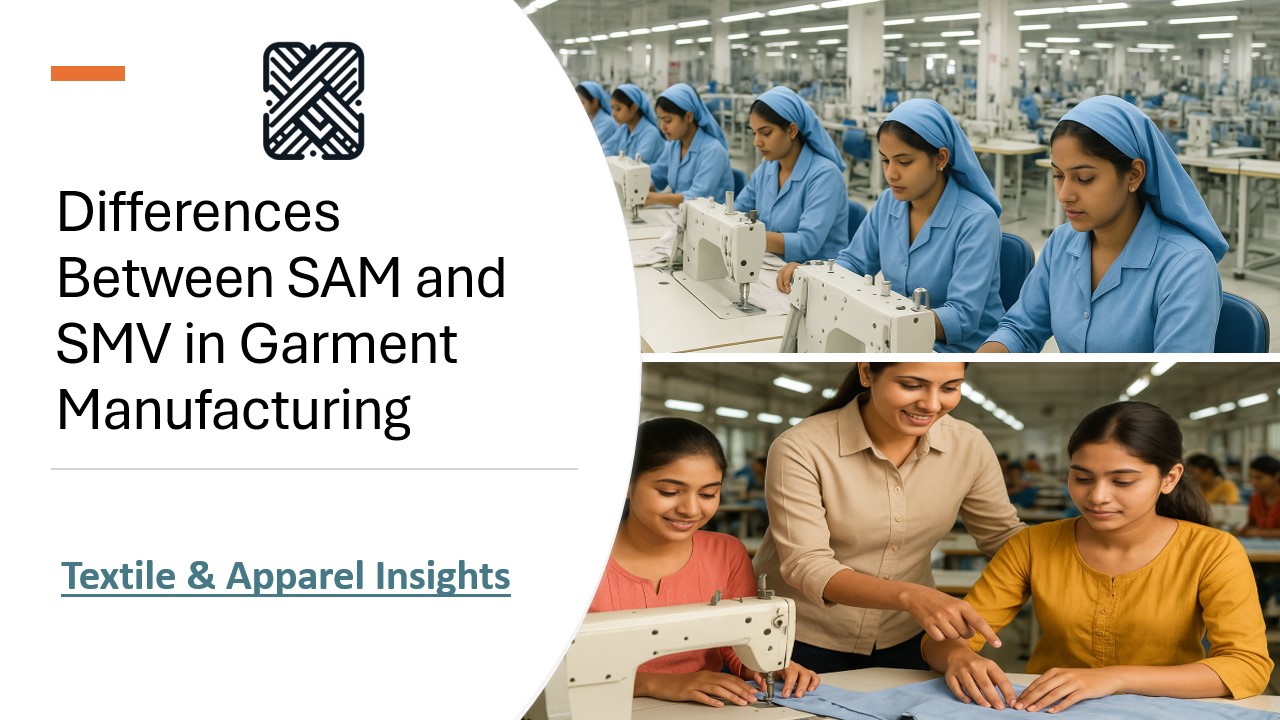
Comprehensive comparison between SMV and SAM concepts in garment manufacturing, showing their definitions, formulas, components, and key applications
Fundamental Concepts and Definitions
Standard Minute Value (SMV): The Foundation of Time Measurement
Standard Minute Value (SMV) represents the time required for a qualified worker operating at standard performance level to complete a specific garment operation under normal working conditions. SMV is essentially the basic time or core time needed to perform a task, excluding additional allowances for real-world working conditions.
The concept originated from European industrial engineering practices and has become widely adopted in manufacturing systems influenced by European consultants. SMV serves as the fundamental building block for all other time-related calculations in garment manufacturing, providing a standardized baseline for measuring work content. SMV is calculated using the formula:
SMV = Observed Time × Performance Rating.
This calculation yields the theoretical minimum time required to complete an operation when performed by a skilled operator working at 100% efficiency under ideal conditions. The performance rating factor accounts for variations in operator speed and skill level, normalizing the observed time to a standard benchmark.
Standard Allowed Minute (SAM): Practical Time Standards
Standard Allowed Minute (SAM) extends beyond SMV by incorporating additional time allowances that account for realistic working conditions in garment manufacturing environments. SAM represents the total time required to complete a garment operation, including provisions for unavoidable delays, personal needs, and operational requirements that occur during actual production.
The fundamental relationship between SAM and SMV is expressed as:
SAM = SMV + Allowances.
These allowances typically include bundle handling time, machine maintenance requirements, and personal needs, making SAM a more practical and achievable standard for production planning and performance measurement.
SAM has its roots in American industrial engineering practices and is predominantly used in manufacturing systems influenced by American consultants. This regional preference has led to some confusion in global manufacturing operations, where both terms may be encountered depending on the consulting background and established practices.
Technical Differences and Characteristics
Scope and Time Coverage
The primary distinction between SMV and SAM lies in their scope of time measurement. SMV focuses exclusively on the core operation time, representing the pure working time required to complete a specific task. This narrow focus makes SMV ideal for theoretical calculations and baseline measurements, but it does not reflect the realities of actual production environments.
SAM provides a comprehensive time measurement that encompasses the complete task cycle, including all necessary supportive activities and unavoidable delays. This broader scope makes SAM more suitable for practical production planning, capacity calculation, and realistic performance targets.
Allowance Integration
SMV calculations deliberately exclude allowances, maintaining focus on the core operation time. This exclusion allows SMV to serve as a consistent baseline for comparative analysis across different operations, operators, and production environments.
SAM systematically incorporates multiple types of allowances that reflect real-world working conditions. Bundle allowances typically account for 10% of basic time, covering activities such as material handling, bundle opening, and work organization. Machine and personal allowances usually range from 15-20% of basic time, addressing equipment maintenance, personal needs, and fatigue recovery.
Regional and Industry Preferences
The choice between SMV and SAM terminology often reflects regional industrial engineering traditions and consulting influences. European-influenced systems typically emphasize SMV as the primary measurement unit, focusing on precise operation timing and method optimization. American-influenced systems commonly adopt SAM as the standard measurement, emphasizing practical implementation and realistic production planning.
Many modern garment manufacturers operate with both systems simultaneously, using SMV for technical analysis and method improvement while employing SAM for production planning and costing purposes. This dual approach allows organizations to benefit from both the analytical precision of SMV and the practical applicability of SAM.
Detailed Calculation Methodologies
SMV Calculation Process
The calculation of SMV follows a systematic approach that begins with time study methodology. Industrial engineers observe skilled operators performing specific operations over multiple cycles, typically 5-10 repetitions, to establish reliable timing data. The observed times are recorded using precision stopwatches or electronic timing devices to ensure accuracy.
Performance rating constitutes a critical component of SMV calculation, requiring industrial engineers to assess operator efficiency relative to standard performance levels. This subjective evaluation considers factors such as operator skill, work pace, method adherence, and overall effectiveness. Performance ratings typically range from 60% to 120%, with 100% representing standard performance expectations.
The basic time calculation applies the performance rating to the average observed time:
Basic Time = Average Observed Time × Performance Rating.
For example, if an operator completes a collar joining operation in an average of 0.522 minutes with a performance rating of 85%, the SMV would be: 0.522 × 0.85 = 0.444 minutes.
| Step | Value | Formula/Calculation |
| Observed Time (Average) | 0.522 minutes | Sum of 5 cycles ÷ 5 |
| Performance Rating | 85% | Observed operator efficiency |
| SMV (Basic Time) | 0.444 minutes | 0.522 × 0.85 |
| Bundle Allowance (10%) | 0.044 minutes | 0.444 × 0.10 |
| Machine & Personal Allowance (20%) | 0.089 minutes | 0.444 × 0.20 |
| SAM (Total Time) | 0.577 minutes | 0.444 + 0.044 + 0.089 |
SAM Calculation Framework
SAM calculation builds upon the SMV foundation by incorporating systematic allowances that address practical production requirements.
The comprehensive SAM formula is:
SAM = SMV + Bundle Allowances + Machine and Personal Allowances.
Bundle allowances typically constitute 10% of the SMV and account for time spent handling material bundles, organizing work pieces, and managing workflow between operations. These allowances recognize that operators must spend time beyond core sewing activities to maintain production flow.
Machine and personal allowances generally range from 15-20% of SMV, addressing various factors that impact operator productivity. Machine allowances cover equipment maintenance activities such as needle changes, thread replacement, tension adjustments, and minor repairs. Personal allowances provide time for physiological needs, brief rest periods, and fatigue recovery.
Predetermined Time Standards (PTS) Method
An alternative approach to SMV calculation utilizes Predetermined Time Standards (PTS) such as General Sewing Data (GSD) or Methods Time Measurement (MTM). These systems break down operations into fundamental motion elements, each assigned predetermined time values in Time Measuring Units (TMUs).
GSD represents a specialized PTS system developed specifically for the garment industry, consisting of 36 standardized data elements across 7 categories. Each motion element has a predetermined TMU value, where 1 TMU = 0.0006 minutes. Industrial engineers analyze operations by identifying constituent motions and summing their TMU values to calculate total operation time.
This method offers significant advantages in terms of consistency, accuracy, and speed compared to traditional time study approaches. PTS methods eliminate the subjectivity of performance rating and allow for time calculation before production begins. However, they require specialized training and may not capture all operational nuances specific to individual production environments.
Practical Applications and Industry Usage
Production Planning and Capacity Management
SMV serves as the foundation for theoretical capacity calculations and method optimization initiatives. Production planners use SMV data to determine minimum time requirements and establish baseline productivity metrics.
The formula for theoretical daily production capacity is:
Capacity = (Available Minutes per Day) ÷ SMV per Garment.
SAM provides more realistic production planning parameters by incorporating practical working conditions. Manufacturing managers rely on SAM for actual capacity planning, considering real-world factors that affect productivity.
The practical daily production formula becomes:
Production = (Available Minutes × Line Efficiency) ÷ SAM per Garment.
Cost Estimation and Labor Costing
Cost per minute (CPM) calculations form the basis for labor cost estimation in garment manufacturing.
The fundamental CPM formula is:
CPM = Total Labor Cost ÷ Total Minutes Produced.
SMV provides the base time component for theoretical labor costs, while SAM offers more accurate cost estimates for practical budgeting purposes.
For example, if a factory’s monthly labor cost is $50,000 and operators work 12,480 minutes per month at 80% efficiency, the CPM calculation would be: $50,000 ÷ (12,480 × 0.80) = $5.01 per minute. A garment with 15 minutes SAM would have a labor cost of: 15 × $5.01 = $75.15.
Performance Measurement and Efficiency Analysis
SMV enables operator skill assessment and method comparison by providing standardized time benchmarks. Industrial engineers use SMV data to identify performance variations and improvement opportunities across different operators and production methods.
SAM supports line efficiency measurement and production target setting by incorporating realistic working conditions.
Line efficiency is calculated as:
Efficiency = (Actual Production × SAM) ÷ (Available Minutes × Number of Operators).
This comprehensive approach provides more meaningful performance indicators for manufacturing management.
Advanced Applications and Strategic Implications
Line Balancing and Workflow Optimization
Both SMV and SAM play crucial roles in line balancing activities that optimize production flow and minimize bottlenecks. SMV data helps identify operations with inherent time differences, enabling targeted method improvement initiatives. SAM values support practical line balancing by accounting for realistic working conditions and allowance requirements.Takt time calculation integrates with both measurement systems to establish production rhythm and cycle planning. Takt time represents the pace required to meet customer demand:
Takt Time = Available Production Time ÷ Customer Demand.
Operations with SMV or SAM values exceeding takt time requirements indicate potential bottlenecks requiring attention.
Quality Management and Standard Setting
SMV provides a foundation for method standardization and quality consistency initiatives. By establishing precise time standards for optimal methods, SMV supports training programs and performance benchmarking across multiple production lines.
SAM enables realistic target setting that considers practical constraints and human factors. This approach supports sustainable performance improvement and worker satisfaction by establishing achievable goals rather than theoretical maximums.
Technology Integration and Digital Manufacturing
Modern garment manufacturing increasingly integrates digital time study tools and computerized work measurement systems. GSDCost and similar software platforms utilize predetermined time standards to calculate SMV and SAM values with greater accuracy and consistency.
Real-time production monitoring systems leverage SAM data to track performance against established standards, enabling immediate corrective actions and continuous improvement initiatives. These digital solutions provide enhanced visibility into production efficiency and support data-driven decision making.
Industry Case Studies and Practical Examples
Implementation Challenges and Solutions
Manufacturing organizations often face challenges when implementing SMV and SAM systems, particularly regarding operator acceptance and measurement consistency. Successful implementations require comprehensive training programs that help operators understand the purpose and benefits of time standards.
Change management strategies should emphasize the supportive rather than punitive nature of time standards, focusing on performance improvement and fair compensation rather than workforce reduction. Organizations that successfully communicate these benefits typically achieve higher adoption rates and sustainable performance improvements.
Best Practices and Lessons Learned
Industry experience demonstrates the importance of regular standard updates to maintain accuracy and relevance. Production methods, equipment capabilities, and operator skills evolve over time, requiring periodic review and adjustment of established standards.
Cross-functional collaboration between industrial engineers, production managers, and operators enhances the quality and acceptance of time standards. Involving operators in the measurement process builds understanding and commitment while capturing valuable insights about practical working conditions.
Future Trends and Developments
Automation and Smart Manufacturing
The evolution toward Industry 4.0 and smart manufacturing is reshaping traditional approaches to time measurement and production planning. Automated sewing equipment and digital monitoring systems provide more precise timing data while reducing reliance on manual time studies.
Artificial intelligence and machine learning applications show promise for predicting optimal SMV and SAM values based on historical data, operator characteristics, and production conditions. These technologies may enhance the accuracy and responsiveness of time standards while reducing measurement costs.
Sustainability and Worker Welfare
Growing emphasis on sustainable manufacturing practices is influencing approaches to time standards and performance measurement. Organizations increasingly recognize the importance of setting realistic standards that support worker welfare while maintaining productivity requirements.
Fair wage initiatives and living wage commitments rely heavily on accurate SMV and SAM calculations to establish appropriate compensation structures. These social responsibility considerations add strategic importance to precise time measurement systems.
Conclusion
The distinction between Standard Allowed Minute (SAM) and Standard Minute Value (SMV) represents more than semantic difference in garment manufacturing terminology. These concepts embody fundamentally different approaches to time measurement, each serving distinct purposes in modern apparel production management. SMV provides the analytical precision necessary for method optimization and theoretical calculations, while SAM offers the practical realism required for effective production planning and performance management.
Understanding these differences enables manufacturing professionals to select appropriate measurement systems based on specific application requirements. Organizations benefit from implementing both concepts strategically, utilizing SMV for technical analysis and continuous improvement while employing SAM for operational planning and worker performance evaluation. This dual approach maximizes the advantages of each system while addressing the diverse needs of modern garment manufacturing operations.
The continuing evolution of manufacturing technology and social responsibility considerations will likely influence future applications of SAM and SMV systems. However, the fundamental principles of accurate time measurement and fair performance standards will remain central to successful garment manufacturing operations. Mastery of these concepts provides essential foundation knowledge for anyone seeking to excel in apparel production management and industrial engineering.
As the garment industry continues to face pressure for increased efficiency, cost reduction, and social compliance, the strategic application of SAM and SMV systems becomes increasingly critical. Organizations that invest in proper understanding and implementation of these time measurement concepts position themselves for sustainable competitive advantage in the global marketplace. The educational foundation provided by this comprehensive analysis supports informed decision-making and effective implementation of these essential manufacturing tools.
References
- https://www.linkedin.com/pulse/how-calculate-garment-sam-standard-allowed-minutes-formula-hossain-xrtdc
- https://www.onlineclothingstudy.com/2019/09/standard-minute-value-smv-definition.html
- https://textilelearner.net/sam-and-smv-calculation-in-garment-industry/
- https://www.coatsdigital.com/en/blog/defining-standard-time/
- https://www.textilecalculations.com/smv-and-sam-measurement-in-garment-industry/
- https://www.onlineclothingstudy.com/2012/09/difference-between-sam-and-smv.html
- https://www.linkedin.com/pulse/al-emran-hossain-lud5c
- https://textilelearner.net/formulas-and-examples-for-industrial-engineer/
- https://garmentsmerchandising.com/how-to-calculate-sam-in-garments-industry/
- https://www.textileindustry.net/ie-formula-for-garments/
- https://garmentio.zohodesk.com/portal/en/kb/articles/calculating-standard-allowed-minutes-sam-through-time-study
- https://gotextilefabrics.com/how-calculate-sam-garment-industry
- https://www.onlineclothingstudy.com/2011/02/how-to-calculate-sam-of-garment.html
- https://garmentsmerchandising.com/how-to-calculate-allowance-time-in-garment-industry/
- https://www.linkedin.com/posts/textilelibrary_smv-sam-garments-activity-7301445464501948417-xGNF
- http://textilemerchandising.com/calculate-allowance-clothing/
- https://apparelresources.com/business-news/manufacturing/ie-apparel-manufacturing-v-determining-allowances/
- https://www.scribd.com/document/888598422/SMV-and-SAM-Measurement-in-Garment-Industry
- https://news.odmya.com/2024/01/12/maximizing-efficiency-mastering-sam-and-smv-in-apparel/
- https://www.onlineclothingstudy.com/2015/01/pros-and-cons-of-setting-up-garment-sam.html
- https://leanstitch.com/industrial-engineering-calculations-garment-production-factory/
- https://www.scribd.com/doc/296228088/SMV-of-Different-Garments
- https://www.scribd.com/presentation/442863143/GSD-Presentation-ENG
- https://cronometras.com/en/blog/what-is-gsd-in-engineering/
- https://www.linkedin.com/pulse/gsd-technique-methods-analysis-setting-time-standards-md-moniruzzaman
- https://www.smartpatternmaking.com/blogs/articles/understanding-time-measuring-unit-tmu-standard-time-and-motion-study
- https://www.scribd.com/doc/224625863/Term-Paper
- https://textilelibrary.wordpress.com/2018/08/01/an-introduction-to-gsd-general-sewing-data/
- https://textilelearner.net/gsd-in-garment-industry-and-its-importance/
- https://cdn.chools.in/tool-kit/Lean%20Six%20Sigma%20-%20CI%20toolkit/POKA+A3+8D+7QC+Tools/CM-Calculation-,SAM%20calculation,basic%20capacity,operator%20performance%20rating.xls
- https://www.textilecalculations.com/calculation-of-garments-cm-cost-of-making-by-sam-or-smv/
- https://www.onlineclothingstudy.com/2013/06/method-of-calculating-cost-per-minute.html
- https://www.scribd.com/document/474388359/Garment-CM-cost-estimation-using-SAM-or-SMV
- https://textileengineering.net/how-to-calculate-cost-per-minute-cpm-in-garment-industry/
- https://www.onlineclothingstudy.com/2011/03/industrial-engineering.html
- https://vidyamitra.inflibnet.ac.in/data-server/eacharya-documents/56b0853a8ae36ca7bfe81449_INFIEP_79/33/ET/79-33-ET-V1-S1__new_unit_5.pdf
- https://www.scribd.com/document/529621068/How-to-calculate-Basic-Pitch-Time
- https://www.coats.com/en/coats-digital/gsdcost/
- https://www.slideshare.net/slideshow/standard-minute-value-smv-in-garments-calculation-and-importance/177744503
- https://www.smartpatternmaking.com/blogs/articles/mastering-garment-sam-calculation-a-step-by-step-guide
- https://ordnur.com/apparel/standard-minute-value-smv-garments-calculation-importance/
- https://www.scribd.com/doc/271190809/What-is-Count
- https://www.scribd.com/document/722882170/SAM
- https://www.scribd.com/document/373823793/SMV-SAM-the-Clear-Concept
- https://blogs.texchangeglobal.com/how-is-standard-allowance-minute-calculated-in-textile-manufacturing/
- https://www.youtube.com/watch?v=0CHODoYt56E
- https://www.slideshare.net/slideshow/lets-understand-what-are-sam-and-smv/65221693
- https://www.textileindustry.net/sam-smv-calculation-of-a-basic-shirt/
- https://www.atlantis-press.com/article/25860186.pdf
- https://www.fbeinternational.com/mtm-methods-time-measurement/
- https://apparelresources.com/business-news/manufacturing/mtm-an-institution-by-itself/
- https://www.scribd.com/document/623354459/An-introduction-to-GSD-General-Sewing-Data-TEXTILE-LIBRARY
- https://en.wikipedia.org/wiki/Methods-time_measurement
- https://ppl-ai-code-interpreter-files.s3.amazonaws.com/web/direct-files/9643b44a6ace93846804483fb9d6ec05/9885607b-9d55-4ec1-899c-8f8518a40028/89f644db.csv
- https://ppl-ai-code-interpreter-files.s3.amazonaws.com/web/direct-files/9643b44a6ace93846804483fb9d6ec05/8db4d0fc-693f-4415-90e5-aa3dc1f207d5/42c2a699.csv
- https://ppl-ai-code-interpreter-files.s3.amazonaws.com/web/direct-files/9643b44a6ace93846804483fb9d6ec05/8db4d0fc-693f-4415-90e5-aa3dc1f207d5/a818c276.csv
- https://ppl-ai-code-interpreter-files.s3.amazonaws.com/web/direct-files/9643b44a6ace93846804483fb9d6ec05/8db4d0fc-693f-4415-90e5-aa3dc1f207d5/da235158.csv